Showing posts with label woodland. Show all posts

24 June 2016

Rhody Bashing on the west shore of Windermere


The woodlands of High Furness have had a long history of charcoal production dating back at least to the 13th century. The 17th century saw an increase in demand for charcoal from the Iron Industry and much of the woodland along the west shore of Windermere was managed for its production up to the mid 19th century.

Charcoal was burned on site in turf mounds situated on charcoal burning platforms or 'pitsteads'.  These were large flat clearings made within the woods, either earthen or stone built. Over 250 of these pitsteads, along with 'collier paths' -  tracks for the transportation of the underwood and charcoal to and from production sites, can still be seen throughout the woods around Claife.

One such wood, Pate Crag Coppice, was a working coppice from at least the 17th century through to the early early 20th. In the years since its coppice stools have grown into impressive multi-stemmed trees. But the woods have also suffered an invasion of rhododendron which now threaten this historic woodland.

A non-native invasive species, rhododendron prevents native flora from growing due to its dense evergreen shade. It colonises an area through stem layering and by producing millions of seeds, and is difficult to remove thanks to its 'tenacity of life', making it the bane of conservationists. 

Much work has been done by the rangers in recent years to remove rhododendron and improve woodland flora and bio-diversity. But the successful eradication of rhododendron requires a programme of managed removal, monitoring and control over a number years - aka Rhody Bashing.
Rhododendron in Pate Crag Coppice.
No rhododendron in Pate Crag Coppice.

As part of Volunteers' Week (1-12 June) a group of 8 members from the South Lakes Volunteer Group joined us on a bright, hot Tuesday morning for a day of Rhody Bashing at Pate Crag Coppice. Led by Richard, our Woodland Ranger, and armed with bow saws, loppers, flapjack and lots of water we set off from the lakeside track over the steep and sometimes slippery terrain of the woods to one of the pitsteads that would serve as our base for the day.

There are several ways to tackle rhododendron. You can pull up the seedlings by the roots, dry the roots and snap the stem; saw off branches at the base and treat the stump with herbicide; spray the leaves with herbicide where there is no risk of over-spray effecting surrounding flora or contaminating a watercourse; or use mechanical flailing.

Given our number and the size of the near by rhodies, plus the steepness of the terrain and potential risk of over-spray, our method of choice was to cut and saw the branches down to the stump. We left about a foot standing with a few leaves sticking up to act as a flag. This is to help locate the stump and treat it with herbicide at a later date. The cut branches were then piled up ready to be burned. Yes, just what you need on a hot, sweaty day with no breeze. A fire. Luckily one of our number was an ex-fireman more than happy to get the fire going.

Volunteer tackling a large rhody stump.

Rhody stump with 'flag' of leaves.

In a manner one can only imagine was similar to those who worked these woods for charcoal in years gone by we formed an effective production line from shrub to fire. One or two small groups where based up slope cutting off branches then lobbing or dragging them down slope to the charcoal platform. Another group cut up the pile of branches into smaller manageable stacks while the final group fed and managed the fire. In this fashion we cleared all the rhody sites we hoped to in good time. 

Where the rhododendron once stood was now an expanse of bare ground. A reminder of just how damaging to the habitat it can be. 

Bare ground where rhododendron once stood.
The fire can be seen down slope in the background.
 
An area of Pate Crag Coppice where the rhody has previously been removed.

Light gets through and new life grows again.

~

Rhododendron ponticum was present in Britain in previous interglacials but didn't re-colonise here in the post-glacial. Native to parts of southern Europe it was (re)introduced to Britain in 1763 and became abundant throughout the 18th and 19th centuries as an ornamental plant and as game cover. It has now widely naturalised. Particularly on acid soils and in shaded woodland.

It damages the habitat it invades by dominating the area. It spreads laterally through branch layering creating its dense, impenetrable growth which prevents light from getting to other species. Its leaves and buds contain toxic chemicals making it unpalatable to grazing animals. These chemicals may also act as an inhibitor to the growth of competing species further adding to its domination. Its honey is poisonous to humans and bees. It can be a host for fungal pathogen Phytophthora.

Where the native flora ceases to be so too do the animals which live off the flora and hence the animals that live of those animals and so on leaving the area virtually barren of all life except the rhododendron. Even in woodland, where trees can exist above its dense shade, no new saplings can seed. So as the existing trees die off only the rhododendron will remain.

Such tenacity makes eradication costly, labour intensive and time consuming. Even after removing existing growth and treating with herbicides the millions of tiny seeds that are produced each year are easily spread far and wide by the wind making regrowth highly likely. A site needs to to be revisited over successive years to repeatedly control the regrowth before the site can be declared free of rhododendron.

Yet, despite all this, in its exotic form the bright flowers and twisted branches can look quite spectacular.
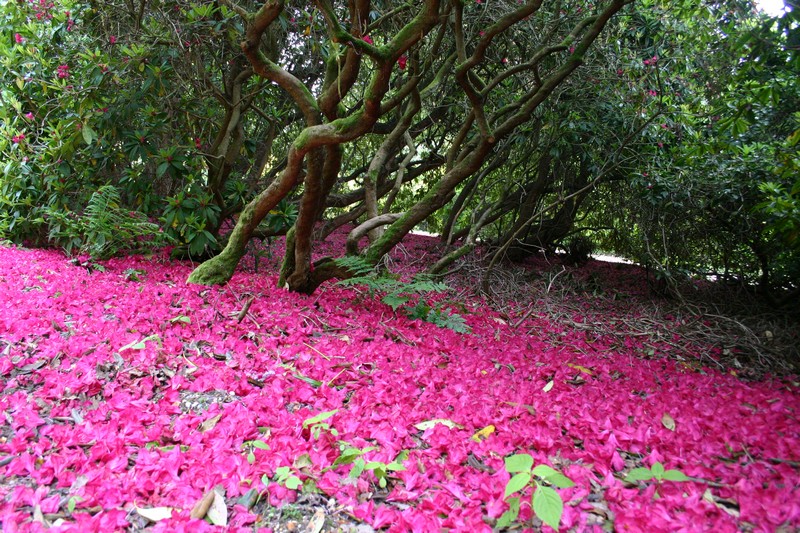
Rhododendron Wood at Leith Hill.

But back to the bashing...

~


A new day, a new site and a new volunteer group.

Volunteers from a group formed by the Windermere Reflections project joined us at Wray Castle. Ornamental rhododendron can be seen lining the edge of woodland around the Wray estate, however, invasions further into the woods once again threaten the habitat.

There's rhody in there somewhere.

The rhody here were smaller and more dispersed than at Pate Crag. The difficulty, however, was in getting to them through the overgrown ferns and brambles.

The site had recently seen some rhody bashing and piles of dried branches were lying waiting for us to put them on the fire. Again, luckily, we had a retired fireman amongst us to help manage the fire. This was important as we had no 'ready made' fire site like the charcoal burning platforms. Instead we cleared a suitable area of ferns, with paths to and from the site, where a small controlled fire could be set and managed.

Piles of branches from previous visit.

Dragging branches though pathways to the fire.

Retired fireman Steve managing the fire.
 
Like the day before the team worked efficiently cutting, treating, dragging and burning, despite the hot weather, until the thunder storm came and we all retreated to the castle for a well earned cup of tea.

Rain stops play.

As the rain subsided we returned to tidy up and pile the un-burned branches ready for the next visit.

Stumps treated with pesticide.
The blue dye helps identify which stumps have been treated.
 
Both sites will need to be revisited on several more occasions over the coming years before the work is complete. Such is the ongoing task of Rhody Bashing.

A huge thanks to all the volunteers from South Lakes Volunteer Group and Windermere Reflections for all their hard work in taking us one step closer to having rhody-free woodland.


27 May 2016

In praise of bluebells


In praise of bluebells

A fine and subtle spirit dwells
In every little flower,
Each one its own sweet feeling breathes
With more or less of power.
There is a silent eloquence
In every wild bluebell
That fills my softened heart with bliss
That words could never tell.

Anne Bronte, 1840.

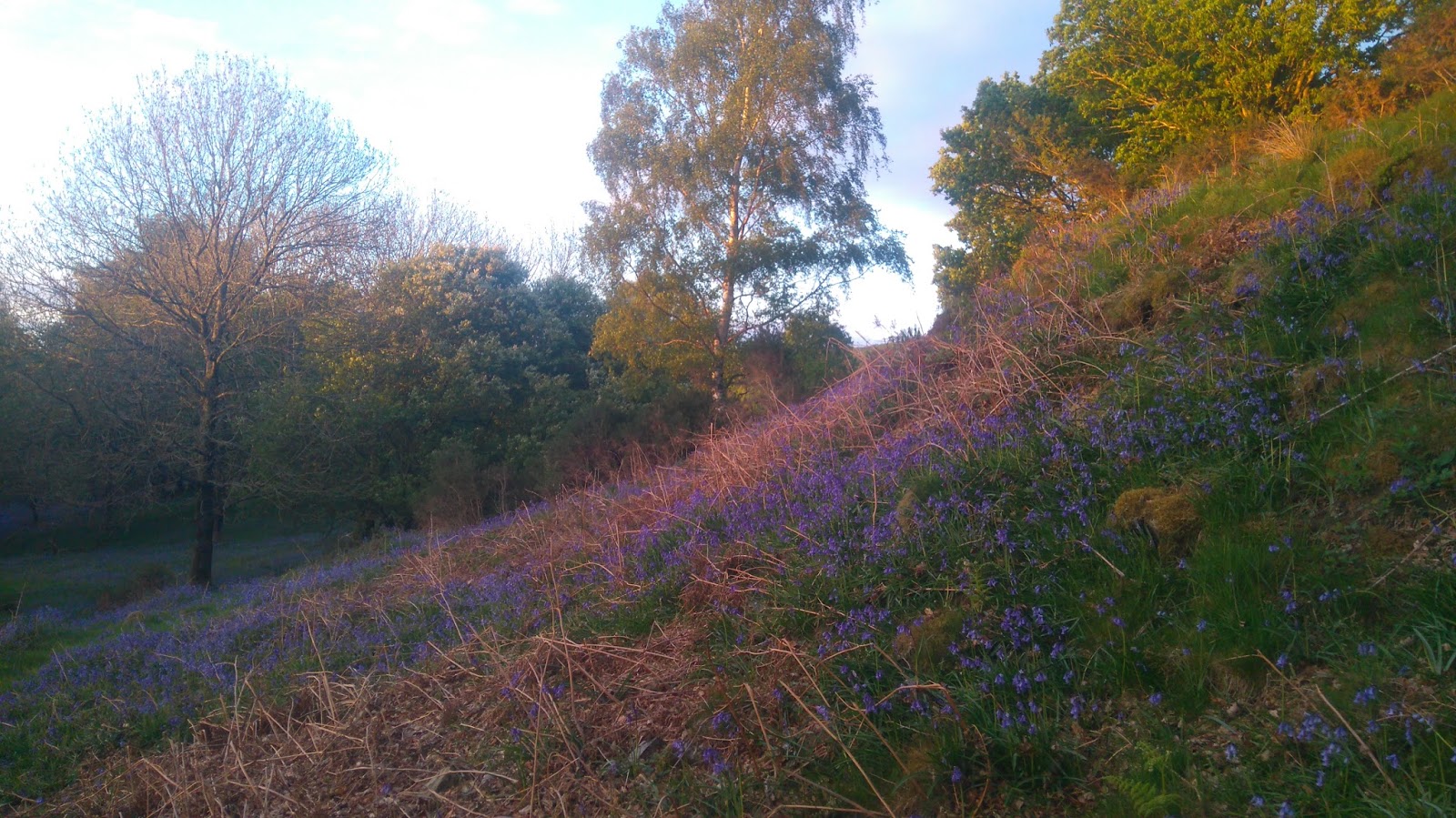
 They’re on the wane now, those carpets of frosted blue, melting back into the woodland floor as the mercury rises and the canopy closes over. Yet for an all-too-brief window every spring, bluebells bring woods all over Britain bursting into life. To many these azure seas of flowers are as emblematic of the returning sun and lengthening days as the call of cuckoos or the sight of swallows. It’s little wonder that our native hyacinthoides non-scripta is amongst the favourite of the nation’s wildflowers. This charismatic, ‘eloquent’ little flower is rich in folklore and history too, and perhaps because they are found in ‘ancient’ woodland, or perhaps because they contain poisonous glycoside compounds, bluebells have long been associated with fairies. Legend has it that the ‘bells’ were rung to summon fairies to gatherings deep in the woods, but should the ringing fall upon a human ear, alas death would soon come upon that unfortunate soul. 
 
A meeting place for fairies?

To witness the spectacle of a bluebell wood in full bloom, whilst hopefully avoiding an untimely demise, there are few better places than here in the Lake District. Bluebells have a preference for oceanic climates, so the UK, and the west coast in particular, with our prevailing weather bringing mild and wet fronts off the Atlantic, creates the perfect growing conditions. In fact, so well suited are they to our climate that the UK is home to around half the world’s population of hyacinthoides non-scripta.

Bluebells also grow best in undisturbed soil, in ground that has remained free from the plough or other intrusions for as long as possible. They tend to take a long time to become established in new habitat, yet this apparent torpidity also means that they can linger long after conditions have changed. Like organic archaeology, to come across an open field of bluebells is to bear witness to a changing landscape, a persisting footprint of a now-vanished habitat. They, along with a handful of other plants, are an indicator of ancient woodland. Ancient in this sense meaning pre- 1600 AD, before maps became widely available and woodland management became commonplace, though some may have lineage that traces all the way back to the most recent ice-age, 10,000 years ago. It’s a rare and shrinking habitat, covering just 2% of the UK’s land surface, though unfortunately it’s rarity often doesn’t equate to value, and many sites remain unprotected in law, at the mercy of human development and exploitation.
Bluebells in open habitat are an indicator of ancient woodland.

Bluebells themselves however, do enjoy a certain level of protection. Although not officially endangered, since 1998 it has been illegal to collect them for sale, and they are further safeguarded from intentional uprooting under the Wildlife and Countryside Act of 1981. The major threats to our native flowers however, come in rather more subtle guises than unscrupulous plant collectors. They first started to appear in the 1960’s, immigrants from Spain escaping from confinement in gardens and parks. Over the following decades increasing amounts of this modern-day Spanish armada has appeared in our woodlands. More robust, more adaptable, and more vigorous than UK bluebells, hyacinthoides hispanica will out-compete native flowers wherever they gain a foothold. To further cloud the picture the two species will readily interbreed, producing a hybridized variety with characteristics of both, and which could ultimately lead to the loss of the genetically distinct non-scripta species. Ominously, in a recent survey by the charity Plantlife, it was found that one in six bluebell woods contained either Spanish or hybrid bluebells alongside native UK plants.

Recognising the three varieties of bluebell now encountered in the UK woodlands (image reproduced courtesy of Cumbria Wildlife.org).

Yet it is it is a different threat which represents the most uncertain future for our beloved bluebells. Native seeds can and are being banked. Spanish invaders can to an extent be eradicated (though it is illegal to uproot any plant without landowner consent). A changing climate however, could see bluebell carpets disappear into memory as the ecological niche to which they are so superbly adapted is swallowed up by shifting patterns and seasons.  If the trend for earlier springs continues, the advancing overhead canopy and competition from other plants on the woodland floor could close the window on bluebells forever.
Could sights like this become a thing of the past?

I for one hope not. I hope that the spectacle of a bluebell wood in full bloom, surely one of the most delightful and uplifting treasures of the British countryside, is around for many years to come. I hope that future generations can experience and wonder at their subtle majesty, and fill their own softened hearts with bliss as they do so.

29 January 2016

Winter Work

This week's countryside blog comes from the Upland Ranger team based in the South Lakes area. 

When the team are working in the Fells a question we often get asked is:
"Do you work up here all year round?"
The answer to this is that we don't and this blog is about what we might be doing when we are not tackling erosion in the Fells of the Lake District.

We do spend much of the year in the Mountains and during the months between the clocks going forward an hour and until they go back again we expect to spend nearly all of our working time up in the Fells. This period is sometimes referred to as our "Fell Season".
 
Upland Rangers in their natural habitat during the "Fell Season"
(Taking a break before starting working on Striding Edge)

Outside of this "Fell Season", due to the shorter days and weather conditions, it isn't practical or safe for the team to stay in the Fells and we move onto work in the lower level Countryside. We call this our "Winter Work" programme (although it does include parts of Autumn and Spring too).

In general the team will help with anything that our Ranger colleagues in the South Lakes ask. There is never a shortage of lower level countryside work and we can find ourselves in high demand (it is not unheard of for our Area Rangers to "fight" for our time).

The examples below, from this years "Winter Work" programme, give an idea of some of the types of work.

We often work with rock and some dry stone walling is a common activity. There are always plenty of wall gaps to repair and we sometimes do some slightly more formal work too.  

Building a Dry Stone Retaining wall for a raised bed at Wray Castle
Another recent task, also using stone, has been some Slate-edged pathway.
A section of Slate-edged path at Wray Castle in progress

A common task in recent years for our Woodland Ranger is building tree cages to protect young trees.  This year has been no exception. 
Tree Cage under construction
(A nice winter day & a Wetherlam backdrop)

We might repair or construct countryside furniture such as gates, stiles and benches.  
Installing a new Bench at Wray Castle
(Donated by a family with connections to Wray Castle)

The finished Bench
We might also work in other areas of the National Trust where help is needed. For example the recent floods didn't affect our South Lakes area as much other parts of Cumbria and we have provided some support in other areas.
Helping clear a flood damaged fence with volunteers near Ambleside
Each year we usually help the Steam Yacht Gondola team winch Gondola out of Coniston Water and set up the frame to cover her for Winter repairs.    
Steam Yacht Gondola winched out of the water
The work we get involved in can be very varied and the examples above are a small selection based on recent months. Our team could be called on to help with any work needed in order to look after the countryside.

At this time of year we don't completely neglect our upland work and weather permitting we try to fit in some maintenance days. We also have an upland work party with the Fix the Fells Volunteer "Lengthsmen" at least once a month.
A Work Party on Browney Gill with the Fix the Fells Volunteer Lengthsmen
(A fairly grim day, we've had a few of these recently)
We also need to think about preparations for the forthcoming Fell Season and usually need to consider rock for our projects. There is seldom sufficient rock close enough to the paths we are going to work on and we may need to fill "heli-bags" so rock can be lifted to site by helicopter. This needs to be done in the early months of the year so it is ready for when we return to the fells. Carrying the heli-bags up to rock collection sites is often quite a good warm up for the main event of actually filling them.
On route to fill "heli-bags" with Rocks
(Image from 2013, we haven't started rock collection this year yet)
A bonus at this time of year, due to the shorter days, is that the light can be quite striking especially early morning or late afternoon as the sun rises or sets. A couple of recent examples are:
Sunrise along Windermere as the team started work at Wray Castle
Late afteroon light looking along Coniston Water at the end of a working day
If you would like to know more about the daily work of the South Lakes Upland Ranger team they can be found on Twitter @NTLakesFells or for more about Fix the Fells follow this link: Fix the Fells 

Posted by: Nick, Upland Ranger

17 July 2015

Tree TV - for tree geeks everywhere

It's no secret to anyone here at South Lakes that I really, really love the rare small leaved lime trees hidden away in Coniston's gills. These beautiful trees are a direct link to the pre-human 'wildwood' - read more in my old blog post here.

Recently I had the chance to share my love for lime in a different format when Rob, our community ranger, made this atmospheric film one sunny summer's day. Naturally it's mortifying to watch myself on screen but it's great to get the message out about these time-travelling trees. Thanks Rob!


30 April 2015

Beyond the bluebells


Spring in the woods means only one thing to lots of people: bluebells! Vibrant carpets of the delicate cyan flowers are a quintessential British experience at this time of year.   

And it’s not just a spectacle; Britain is home to fifty percent of the world population of this species of bluebell. As plants recolonized the northern latitudes after the last Ice Age, bluebells reached Britain just before the sea level rose and cut us off from the continent, so lots of other plant species never arrived here.  In the rest of Europe, bluebells are out-competed by some of these species, whereas in the UK they are free to thrive.


But I’d like to take you beyond the bluebell. Although bluebells are spectacular, my favourite time of the woodland year is actually a couple of weeks earlier, when some of the other woodland wildflowers are the real first sign that spring’s on its way.  Like bluebells, these plants have adapted to life in the woods by flowering before the trees are in leaf, so they make the most of the sun.  They don’t always form such a dramatic carpet on the woodland floor as bluebells, but often the fact that a number of different species are clustered together - with their diversity of colour - makes for a sight to gladden the soul.

Wood anenome


Wood anenomes Anenome nemosa are one of the most important indicators of ancient woodland.  They reproduce through rhizomes (root-like structures) that only spread about six inches a year – this means they don’t colonise new sites easily, and the presence of a large population means that a wood has been undisturbed for a very long time.  They can also provide an interesting clue to previous land uses, as they're sometimes found on open ground – but this is a strong clue that the area has been wooded previously.

Lesser celandine


Like wood anenomes, lesser celandines Ranunculus ficaria can be found in a variety of habitats, but usually give us a clue that the area has been wooded at one point.  It is sometimes known as ‘the spring messenger’ as one of the earliest flowers, and William Wordsworth was inspired to write three poems about the plant – famously, however, the celandine carved on his gravestone is the wrong species, the greater celandine.  It is also sometimes known as pilewort because there is an old folk belief that the crushed roots could make a lotion for piles when mixed with wine or urine!

Wood sorrel


Wood sorrel Oxalis acetosella is probably my favourite woodland wildflower despite its ubiquity.  It particularly thrives in cool, shady woods  - of which there's no shortage round here - and can tolerate shade much darker than other plants. In the Lakes, it often grows out of the mossy carpet on the woodland floor or even from moss growing on tree branches, creating lush hanging gardens in the canopy.  The leaves are delicious and taste of apple peel, but don’t eat too many as they also contain Oxalic acid.  Wood sorrel is one of the more widespread flowers globally and is native as far north as Iceland, south down to Greece, and east as far as Japan!

Wild garlic 

Wild garlic Allium ursinum is another very common flower of damp woodlands and lends the woods their distinctive garlicky aroma in early spring.  The latin name means ‘Bear’s garlic’ and is so-named because where they still exist in Europe, brown bears love to truffle up the roots! Both the leaves and flowers are edible and have a more gentle taste than culinary garlic – wild garlic risotto is a personal favourite.

Primrose


Primrose Primula vulgaris has been under threat in England over the last few decades because of people digging plants up to put them in their garden – fortunately attitudes have changed and this sort of thing is much less common now.  Primroses can be seen anywhere that’s undisturbed, cool and slightly shady, so our Lake District oakwoods are great places to find the lemon yellow rosettes. 

Get out and see 'em!

The South Lakes is home to lots of fantastic native woodland so it’s the perfect place to get out and see woodland wildflowers in the spring.  The woodlands on Windermere’s west shore, along the Yewdale bridleway, above Glen Mary car park, or along Coniston’s east shore are particularly special places with rich flora and incredible atmosphere – make sure you don’t miss the spectacle, it changes day by day at this time of year!