In praise of bluebells
A fine and subtle spirit dwells
In every little flower,
Each one its own sweet feeling breathes
With more or less of power.
There is a silent eloquence
In every wild bluebell
That fills my softened heart with bliss
That words could never tell.
In every little flower,
Each one its own sweet feeling breathes
With more or less of power.
There is a silent eloquence
In every wild bluebell
That fills my softened heart with bliss
That words could never tell.
Anne Bronte, 1840.
They’re on the wane now, those carpets of frosted blue,
melting back into the woodland floor as the mercury rises and the canopy closes
over. Yet for an all-too-brief window every spring, bluebells bring woods all
over Britain bursting into life. To many these azure seas of flowers are as
emblematic of the returning sun and lengthening days as the call of cuckoos or
the sight of swallows. It’s little wonder that our native hyacinthoides non-scripta is amongst the favourite of the nation’s
wildflowers. This charismatic, ‘eloquent’ little flower is rich in folklore and
history too, and perhaps because they are found in ‘ancient’ woodland, or
perhaps because they contain poisonous glycoside compounds, bluebells have long
been associated with fairies. Legend has it that the ‘bells’ were rung to summon
fairies to gatherings deep in the woods, but should the ringing fall upon a
human ear, alas death would soon come upon that unfortunate soul.
 |
| A meeting place for fairies? |
To witness the spectacle of a bluebell wood in full bloom,
whilst hopefully avoiding an untimely demise, there are few better places than
here in the Lake District. Bluebells have a preference for oceanic climates, so
the UK, and the west coast in particular, with our prevailing weather bringing
mild and wet fronts off the Atlantic, creates the perfect growing conditions.
In fact, so well suited are they to our climate that the UK is home to around
half the world’s population of hyacinthoides
non-scripta.
Bluebells also grow best in undisturbed soil, in ground that
has remained free from the plough or other intrusions for as long as possible. They
tend to take a long time to become established in new habitat, yet this
apparent torpidity also means that they can linger long after conditions have
changed. Like organic archaeology, to come across an open field of bluebells is
to bear witness to a changing landscape, a persisting footprint of a
now-vanished habitat. They, along with a handful of other plants, are an
indicator of ancient woodland. Ancient in this sense meaning pre- 1600 AD,
before maps became widely available and woodland management became commonplace,
though some may have lineage that traces all the way back to the most recent
ice-age, 10,000 years ago. It’s a rare and shrinking habitat, covering just 2%
of the UK’s land surface, though unfortunately it’s rarity often doesn’t equate
to value, and many sites remain unprotected in law, at the mercy of human development
and exploitation.
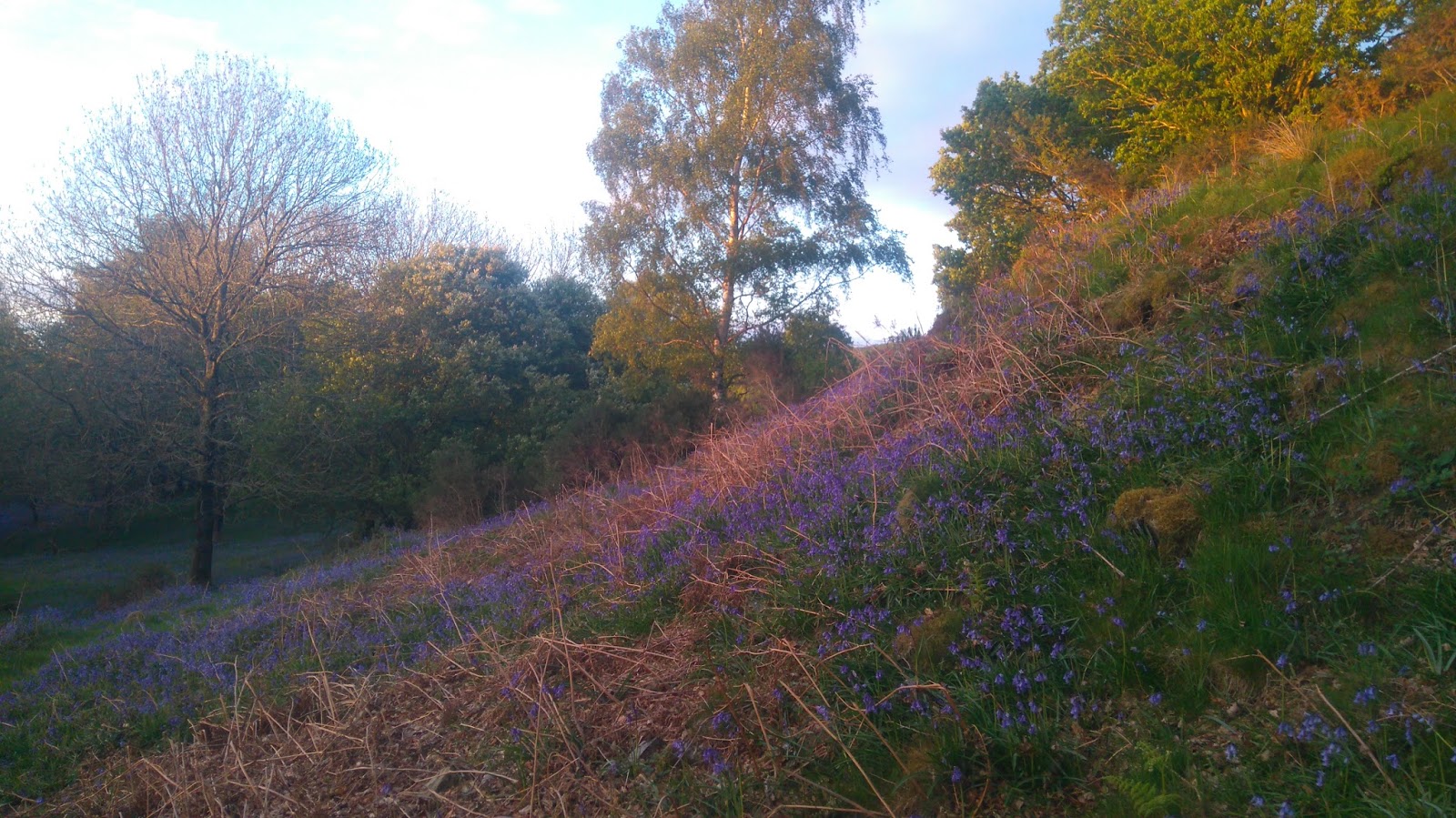 |
| Bluebells in open habitat are an indicator of ancient woodland. |
Bluebells themselves however, do enjoy a certain level of
protection. Although not officially endangered, since 1998 it has been illegal
to collect them for sale, and they are further safeguarded from intentional
uprooting under the Wildlife and Countryside Act of 1981. The major threats to
our native flowers however, come in rather more subtle guises than unscrupulous
plant collectors. They first started to appear in the 1960’s, immigrants from Spain
escaping from confinement in gardens and parks. Over the following decades increasing
amounts of this modern-day Spanish armada has appeared in our woodlands. More
robust, more adaptable, and more vigorous than UK bluebells, hyacinthoides hispanica will out-compete
native flowers wherever they gain a foothold. To further cloud the picture the
two species will readily interbreed, producing a hybridized variety with
characteristics of both, and which could ultimately lead to the loss of the
genetically distinct non-scripta species.
Ominously, in a recent survey by the charity Plantlife, it was found that one
in six bluebell woods contained either Spanish or hybrid bluebells alongside
native UK plants.
 |
| Recognising the three varieties of bluebell now encountered in the UK woodlands (image reproduced courtesy of Cumbria Wildlife.org). |
Yet it is it is a different threat which represents the most
uncertain future for our beloved bluebells. Native seeds can and are being
banked. Spanish invaders can to an extent be eradicated (though it is illegal
to uproot any plant without landowner consent). A changing climate however,
could see bluebell carpets disappear into memory as the ecological niche to
which they are so superbly adapted is swallowed up by shifting patterns and
seasons. If the trend for earlier
springs continues, the advancing overhead canopy and competition from other
plants on the woodland floor could close the window on bluebells forever.
 |
| Could sights like this become a thing of the past? |
I for one hope not. I hope that the spectacle of a bluebell
wood in full bloom, surely one of the most delightful and uplifting treasures
of the British countryside, is around for many years to come. I hope that
future generations can experience and wonder at their subtle majesty, and fill
their own softened hearts with bliss as they do so.


