Showing posts with label volunteers. Show all posts

24 June 2016

Rhody Bashing on the west shore of Windermere


The woodlands of High Furness have had a long history of charcoal production dating back at least to the 13th century. The 17th century saw an increase in demand for charcoal from the Iron Industry and much of the woodland along the west shore of Windermere was managed for its production up to the mid 19th century.

Charcoal was burned on site in turf mounds situated on charcoal burning platforms or 'pitsteads'.  These were large flat clearings made within the woods, either earthen or stone built. Over 250 of these pitsteads, along with 'collier paths' -  tracks for the transportation of the underwood and charcoal to and from production sites, can still be seen throughout the woods around Claife.

One such wood, Pate Crag Coppice, was a working coppice from at least the 17th century through to the early early 20th. In the years since its coppice stools have grown into impressive multi-stemmed trees. But the woods have also suffered an invasion of rhododendron which now threaten this historic woodland.

A non-native invasive species, rhododendron prevents native flora from growing due to its dense evergreen shade. It colonises an area through stem layering and by producing millions of seeds, and is difficult to remove thanks to its 'tenacity of life', making it the bane of conservationists. 

Much work has been done by the rangers in recent years to remove rhododendron and improve woodland flora and bio-diversity. But the successful eradication of rhododendron requires a programme of managed removal, monitoring and control over a number years - aka Rhody Bashing.
Rhododendron in Pate Crag Coppice.
No rhododendron in Pate Crag Coppice.

As part of Volunteers' Week (1-12 June) a group of 8 members from the South Lakes Volunteer Group joined us on a bright, hot Tuesday morning for a day of Rhody Bashing at Pate Crag Coppice. Led by Richard, our Woodland Ranger, and armed with bow saws, loppers, flapjack and lots of water we set off from the lakeside track over the steep and sometimes slippery terrain of the woods to one of the pitsteads that would serve as our base for the day.

There are several ways to tackle rhododendron. You can pull up the seedlings by the roots, dry the roots and snap the stem; saw off branches at the base and treat the stump with herbicide; spray the leaves with herbicide where there is no risk of over-spray effecting surrounding flora or contaminating a watercourse; or use mechanical flailing.

Given our number and the size of the near by rhodies, plus the steepness of the terrain and potential risk of over-spray, our method of choice was to cut and saw the branches down to the stump. We left about a foot standing with a few leaves sticking up to act as a flag. This is to help locate the stump and treat it with herbicide at a later date. The cut branches were then piled up ready to be burned. Yes, just what you need on a hot, sweaty day with no breeze. A fire. Luckily one of our number was an ex-fireman more than happy to get the fire going.

Volunteer tackling a large rhody stump.

Rhody stump with 'flag' of leaves.

In a manner one can only imagine was similar to those who worked these woods for charcoal in years gone by we formed an effective production line from shrub to fire. One or two small groups where based up slope cutting off branches then lobbing or dragging them down slope to the charcoal platform. Another group cut up the pile of branches into smaller manageable stacks while the final group fed and managed the fire. In this fashion we cleared all the rhody sites we hoped to in good time. 

Where the rhododendron once stood was now an expanse of bare ground. A reminder of just how damaging to the habitat it can be. 

Bare ground where rhododendron once stood.
The fire can be seen down slope in the background.
 
An area of Pate Crag Coppice where the rhody has previously been removed.

Light gets through and new life grows again.

~

Rhododendron ponticum was present in Britain in previous interglacials but didn't re-colonise here in the post-glacial. Native to parts of southern Europe it was (re)introduced to Britain in 1763 and became abundant throughout the 18th and 19th centuries as an ornamental plant and as game cover. It has now widely naturalised. Particularly on acid soils and in shaded woodland.

It damages the habitat it invades by dominating the area. It spreads laterally through branch layering creating its dense, impenetrable growth which prevents light from getting to other species. Its leaves and buds contain toxic chemicals making it unpalatable to grazing animals. These chemicals may also act as an inhibitor to the growth of competing species further adding to its domination. Its honey is poisonous to humans and bees. It can be a host for fungal pathogen Phytophthora.

Where the native flora ceases to be so too do the animals which live off the flora and hence the animals that live of those animals and so on leaving the area virtually barren of all life except the rhododendron. Even in woodland, where trees can exist above its dense shade, no new saplings can seed. So as the existing trees die off only the rhododendron will remain.

Such tenacity makes eradication costly, labour intensive and time consuming. Even after removing existing growth and treating with herbicides the millions of tiny seeds that are produced each year are easily spread far and wide by the wind making regrowth highly likely. A site needs to to be revisited over successive years to repeatedly control the regrowth before the site can be declared free of rhododendron.

Yet, despite all this, in its exotic form the bright flowers and twisted branches can look quite spectacular.
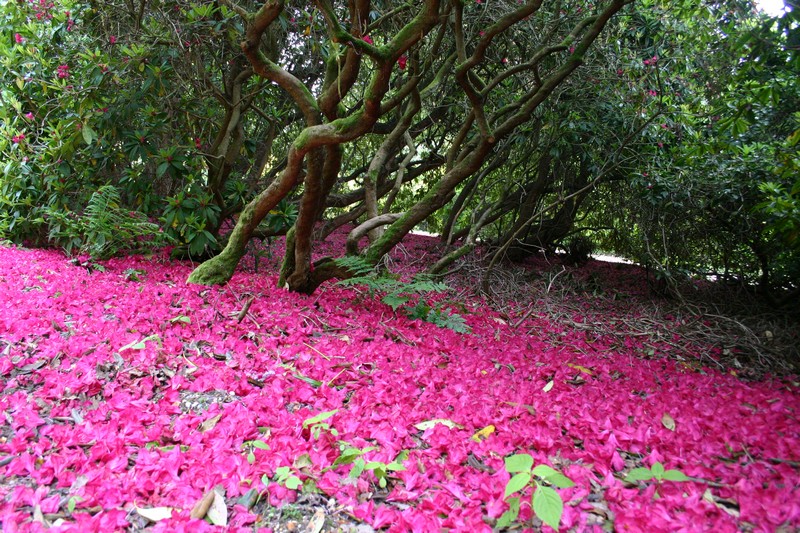
Rhododendron Wood at Leith Hill.

But back to the bashing...

~


A new day, a new site and a new volunteer group.

Volunteers from a group formed by the Windermere Reflections project joined us at Wray Castle. Ornamental rhododendron can be seen lining the edge of woodland around the Wray estate, however, invasions further into the woods once again threaten the habitat.

There's rhody in there somewhere.

The rhody here were smaller and more dispersed than at Pate Crag. The difficulty, however, was in getting to them through the overgrown ferns and brambles.

The site had recently seen some rhody bashing and piles of dried branches were lying waiting for us to put them on the fire. Again, luckily, we had a retired fireman amongst us to help manage the fire. This was important as we had no 'ready made' fire site like the charcoal burning platforms. Instead we cleared a suitable area of ferns, with paths to and from the site, where a small controlled fire could be set and managed.

Piles of branches from previous visit.

Dragging branches though pathways to the fire.

Retired fireman Steve managing the fire.
 
Like the day before the team worked efficiently cutting, treating, dragging and burning, despite the hot weather, until the thunder storm came and we all retreated to the castle for a well earned cup of tea.

Rain stops play.

As the rain subsided we returned to tidy up and pile the un-burned branches ready for the next visit.

Stumps treated with pesticide.
The blue dye helps identify which stumps have been treated.
 
Both sites will need to be revisited on several more occasions over the coming years before the work is complete. Such is the ongoing task of Rhody Bashing.

A huge thanks to all the volunteers from South Lakes Volunteer Group and Windermere Reflections for all their hard work in taking us one step closer to having rhody-free woodland.


15 April 2016

Moving on with the year


With the weather starting to improve now and more groups arriving the team here at the volunteer centre High Wray Basecamp is starting to spend more time outdoors now. We always look forward to this but with the miserable weather we had to put up with over winter we are sometimes quite pleased that we scale back on the amount of time we spend outdoors over the darker months. There are very good reasons for this as there is lots of wrapping up to do of the year just gone, planning to do for the year ahead and more importantly, maintenance of the site itself.


Preparing the walls for repainting, goodbye to gloomy Terracotta
Getting the new Pistachio colour scheme on - sophisticated!

This maintenance occuppied us fully for a couple of weeks as we once more hosted the ‘Basecamp Blitz’, a week long barney of painting and DIY. Being a volunteer centre, we didn't do this on our own and had the help of some very hard working volunteers keen to get going with brush and roller.
Do you like what we've done with the place? The Longland with the first coat on

Now all we need is the roulette wheel - The 'Casino Brown' in full force
Once the walls were complete, we moved on to the floors and laid new carpet tiles down in the Longland block. The old ones were starting to wear out and had so many corners peeling up it was becoming a full time job sticking them back down again. It’s great to have replaced them, even if the new ones have the perhaps inappropriate colour name of 'Casino Brown'!


Now complete we have a lovely fresh feeling to welcome our many groups in for this year - it is a nice thought that improvements that will benefit many volunteers over the coming years have been wrought by volunteers themselves. 
 
But it wasn't all indoor work over the winter and early spring. Part of the aforementioned planning  involved heading up to the hills to look at some of our upland footpath jobs for the year ahead. We got lucky with a rare sunny day for a site visit to Gummer’s How, above Windermere, but weren’t so lucky with a trip up Far Easedale a week later where it seemed winter had returned with a vengeance. Whatever the weather these trips are important as we need to have a very clear idea of the jobs we’ll be tackling with volunteer groups – it’s no good arriving on site and then trying to work out how to tackle a problem when you have 15 volunteers keen to get cracking!

Lucky! The view from the top of Gummers How

Not so lucky! Chilly and wet conditions for the trip up Far Easedale
Since I wrote the most of this blog we've been out tackling the dreaded job of bag filling. Working with the South Lakes upland path team and the Fix the Fells lengthsmen we've been helping each other collecting enough stone for this year’s scheduled upland jobs. The stone is loaded into 1 ton bags ready to be lifted into place by helicopter, always a daunting proposition that we’re pleased to have completed. Finishing this normally coincides with the improvement of the weather and a full move from planning to action, a time of year that can’t come soon enough!


See, it is fun! the lengthsmen mid stone collection


17 December 2015

Black Eye Friday


Black Eye Friday

Around here the Friday before Christmas is traditionally known , by the emergency services, as ‘Black Eye Friday’  it’s the day when the local builders, joiners, plumbers, electricians and people who work the land,  finish work and start their Christmas break . Many local trades people gather  in the local pubs , much drink is taken , tongues are loosened and later in the evening petty rivalries and grievances are aired,  things are said that would be better left unsaid leading to the inevitable ‘wrestling and fisticuffs ‘ and the blackening of eyes !


Lake Windermere just kept on rising


This year however may be a bit different , the recent exceptionally severe flooding and strong winds has meant that houses have been flooded , roads and bridges damaged,  trees felled onto tracks and paths , walls and fences.


Multiple windblown trees across this track on Claife !


Some of our National Trust staff have been affected;  flooded out of  their houses, possessions damaged beyond repair. 


Flooded properties at Strawberry Gardens.


Like our own NT Rangers , many of the local builders are now busier than they have been all year , working hard to repair the damage caused by wind and water, hoping to get people back into their homes before Christmas .


 As I write this we have Rangers and teams of volunteers assessing and prioritising the damage , repairing tracks  and removing windblown trees from paths. Builders  and joiners are delaying their Christmas break ripping out damaged kitchen units and furniture trying to dry out properties quickly so that re-building work can begin. This work will continue well into the new year and some of it will take months !


Cumbrian Spirit

All this paints a bleak picture,  but the reality of life in the Lakes is that we have faced severe weather challenges before; repaired, rebuilt and carried on with our work and our lives and this time will be no different. Most of the businesses are open as usual , the majority of roads and bridges are open , the countryside is accessible , if a little scarred in places .


Moody and magnificent
So come and visit Cumbria and the South Lakes we are open for business and we could do with your support now more than ever. If anything the Lakes is looking even more moody and magnificent , the becks and waterfalls are certainly something to behold,  and Christmas is a great time to be in the Lakes whatever the weather !


Please note : Do check our NT website for opening times  and info as some of our properties close for a Winter break to prepare for the new season.

Happy Christmas

10 July 2015

Bat Man visits Basecamp!

Up here at the volunteer centre we’re proud of the work we do to help look after our special places. But for many groups a stay here involves a lot more than just working with us as there’s plenty to discover in and around our grounds.

So it was that during a recent visit by Glenburn Sports College the word was out amongst the students that Tuesday evening we were due a visit from ‘the Bat Man.’ Not the punchy kicky superhero (no need for that kind of behaviour at Basecamp), but our regional Wildlife and Countryside Advisor, John Hooson, who had kindly given up his evening to come here and talk about our resident bats.


Bat box on the Longland toilet block roof - you'd never guess there's been 190 bats counted coming out of here!

We have, we think, two colonies of Soprano Pipistrelles (Pipistrellus pygmaeus) at High Wray. We normally let groups know about them and have a couple of bat detectors that we lend out, but having John up here to talk to them added an extra level of interest, especially when he brought out his collection of desiccated bats picked up from various sites over the years! He even had a bat skeleton, where you could clearly see the very similar bone structure in their arms to us – they have an elbow and a forearm with four very long fingers on it which the wing is stretched between and even a little thumb.
 
They're tiny! Getting hands on
The bat skeleton with long finger bones clearly (but slightly blurrily) visible
Blowing raspberries

After a ‘bat chat’ full of interesting facts (Did you know bats aren’t blind, they actually have quite good eyesight?) it was getting gloomy enough to turn the detectors on. These clever little devices ‘listen’ for the bats’ high frequency hunting calls and convert the sound to a lower frequency audible to our ears. It wasn’t too long before we started hearing the bats fluttering past us, catching midges on the wing. On occasion we even picked up the ‘raspberry’ sound they make when they are closing in on an insect and intensify their calls.


After a fascinating couple of hours John departed in the Bat Mobile (might have been a Nissan), but the group were enthused enough that they asked to hold on to the detectors for the next night. No trace remained of the Bat Man, except for one thing – we now have our own example of Pipistrelle, which we plan to show to other groups in the future and hopefully spark off an interest in these amazing creatures.
The 'Basecamp Bat' 

By Rob Clarke, Basecamp Community Ranger

26 June 2015

Faffin around in Northern Ireland...

Working for the National Trust has many great benefits, one of the main being you are a part of a national organisation and you have colleagues in loads of interesting and beautiful places, including over in Northern Ireland (which can be easy to forget...sorry NI).  As such Rangers across the Trust have the opportunity (thanks to the generosity of the Mayled family, in memory of Andy Mayled), to link up with other Rangers allowing them to learn, discover and experience somewhere new.  So what greater contrast than the high fells of the Lakes to the hustle and bustle of Northern Ireland's capital Belfast!

From here.....
....to here!
This was the choice I (Upland Ranger Sarah!) made and over 3 days in June I swopped the 14 strong Ranger team in the South Lakes for the some what smaller 3 Ranger team in Belfast... 

The Belfast crew, the green helps them blend in...
Why Belfast I hear you ask?!  Well, I've done a wee bit of traveling, but hadn't yet made it to any part of Ireland, so when I heard about the Ranger link, heading over to Belfast seem a good way to kill two birds with one stone.  It also helped that I knew the Ranger, Craig, from the work I do as a rep with Prospect, the NT's union.  As such it wasn't long before we had dates in the diary, ferries booked and I was getting excited to be somewhere new and completely different.  Only as it turned out it was different...yet the same!

Same old fencing job, different location!
Let me explain.  You see, although the South Lakes has a 13 strong Ranger team, that team is broken down into more specialist teams and day to day I mainly work with the 3 other guys that make up the Upland team.  So rocking up to the Ranger office at Minnowburn and meeting Colin, Mick and Craig felt like a temporary exchange of the usual faces.  Accompanying them was a friendly bustle of volunteers, and lets not forget Bella!

The South Lakes massif
Over the 3 days I got to see some of the main bits of work the guys get up to in Belfast.  From working with school groups pond dipping and in the forest school, to practical work on one of their coastal sites in Port Muck, to the intricacy of project planning a car park development at Minnowburn where they can annually receive over 150,000 visitors.  It's what we as Rangers would expect to be involved in, it's just the balance of jobs or the habitats that may be slightly different. 

Irish language school group
Pond dipping


A very Ranger suitable totem pole, all about cake!
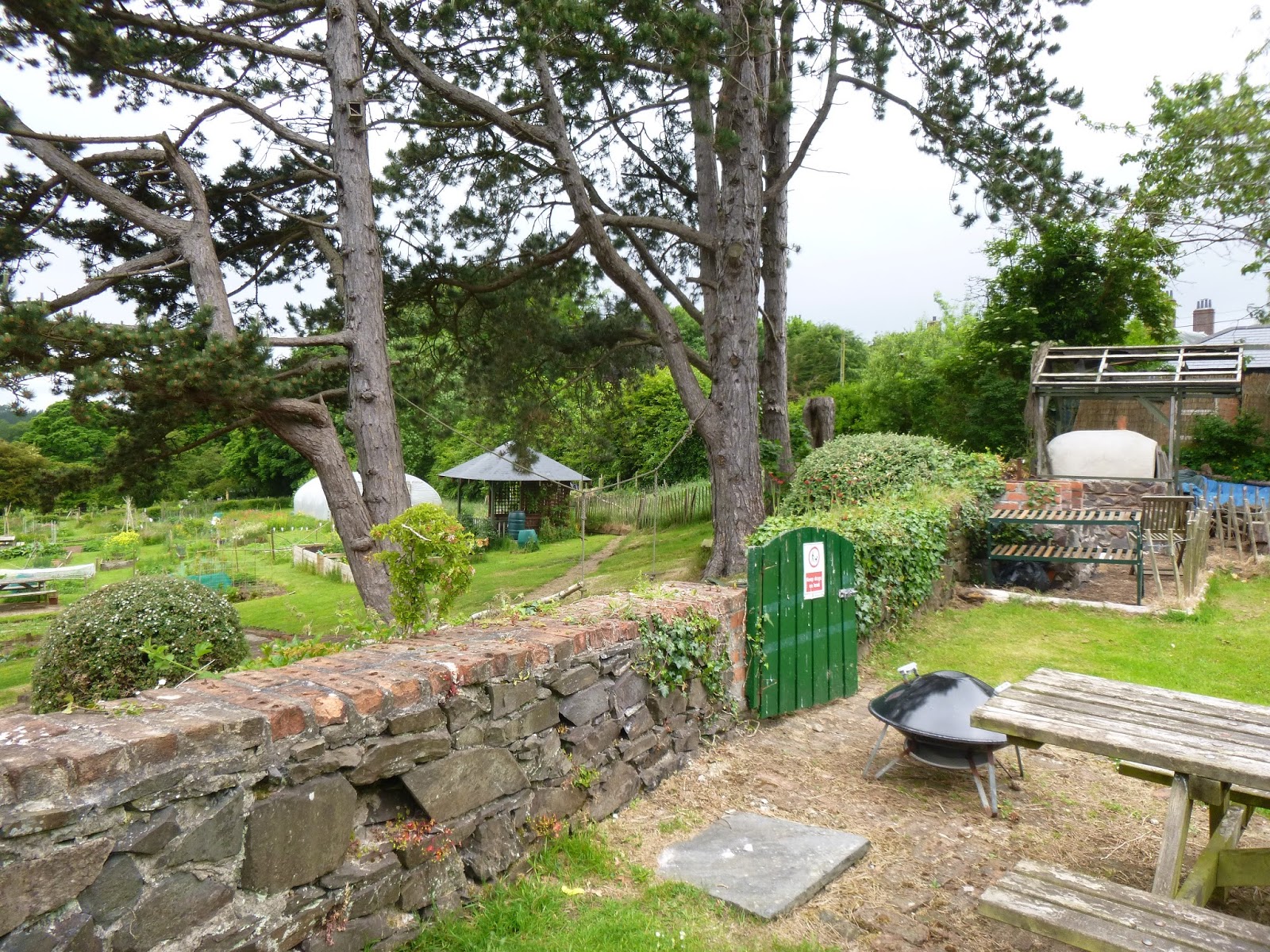
 For example in Belfast the large majority of their volunteer input is from large groups, whether those are corporate groups wanting to get out and do something different, or school groups looking to have a mix of education and conservation.  Partnership working is also key, Minnowburn itself is only 120 acres within the much larger Lagan Valley, covering 3500 acres in total and welcoming between 2-3million visitors a year.  Being on the doorstep to a population of over 300,000 people living in Belfast the opportunities to work with communities are well taken, a great example being the community garden that sits just behind the Ranger office and comes complete with a wood fired pizza oven for those long summer evenings!

Community garden, a great space

All in all it was a really interesting week that I would recommend to all Rangers.  It makes a refreshing change for both sides of the link and allows for plenty of learning, even if to start with you don't know how to articulate what that learning is!  For me though its back to the grind stone and back to home sweet home.

Home...literally- i can see my house!
By Upland Ranger Sarah
Follow us @ntlakesfells