The woodlands of High Furness have had a
long history of charcoal production dating back at least to the 13th century.
The 17th century saw an increase in demand for charcoal from the Iron Industry
and much of the woodland along the west shore of Windermere was managed for its
production up to the mid 19th century.
Charcoal was burned on site in turf
mounds situated on charcoal burning platforms or 'pitsteads'. These were large flat clearings made within
the woods, either earthen or stone built. Over 250 of these pitsteads, along
with 'collier paths' - tracks for the
transportation of the underwood and charcoal to and from production sites, can
still be seen throughout the woods around Claife.
One such wood, Pate Crag Coppice, was a
working coppice from at least the 17th century through to the early early 20th.
In the years since its coppice stools have grown into impressive multi-stemmed
trees. But the woods have also suffered an invasion of rhododendron which now
threaten this historic woodland.
A non-native invasive species,
rhododendron prevents native flora from growing due to its dense evergreen
shade. It colonises an area through stem layering and by producing millions of
seeds, and is difficult to remove thanks to its 'tenacity of life', making it
the bane of conservationists.
Much work has been done by the rangers in
recent years to remove rhododendron and improve woodland flora and
bio-diversity. But the successful eradication of rhododendron requires a
programme of managed removal, monitoring and control over a number years - aka
Rhody Bashing.
 |
| Rhododendron in Pate Crag Coppice. |
 |
| No rhododendron in Pate Crag Coppice. |
As part of Volunteers' Week (1-12 June) a
group of 8 members from the South Lakes Volunteer Group joined us on a bright,
hot Tuesday morning for a day of Rhody Bashing at Pate Crag Coppice. Led by
Richard, our Woodland Ranger, and armed with bow saws, loppers, flapjack and
lots of water we set off from the lakeside track over the steep and sometimes
slippery terrain of the woods to one of the pitsteads that would serve as our
base for the day.
There are several ways to tackle
rhododendron. You can pull up the seedlings by the roots, dry the roots and
snap the stem; saw off branches at the base and treat the stump with herbicide;
spray the leaves with herbicide where there is no risk of over-spray effecting
surrounding flora or contaminating a watercourse; or use mechanical flailing.
Given our number and the size of the near
by rhodies, plus the steepness of the terrain and potential risk of over-spray,
our method of choice was to cut and saw the branches down to the stump. We left
about a foot standing with a few leaves sticking up to act as a flag. This is
to help locate the stump and treat it with herbicide at a later date. The cut
branches were then piled up ready to be burned. Yes, just what you need on a
hot, sweaty day with no breeze. A fire. Luckily one of our number was an ex-fireman
more than happy to get the fire going.
 |
| Volunteer tackling a large rhody stump. |
 | |
| Rhody stump with 'flag' of leaves. |
In a manner one can only imagine was similar to those who worked these woods for charcoal in years gone by we formed an effective production line from shrub to fire. One or two small groups where based up slope cutting off branches then lobbing or dragging them down slope to the charcoal platform. Another group cut up the pile of branches into smaller manageable stacks while the final group fed and managed the fire. In this fashion we cleared all the rhody sites we hoped to in good time.
Where the rhododendron once stood was now an expanse of bare ground. A reminder of just how damaging to the habitat it can be.
 |
| Bare ground where rhododendron
once stood.
The fire can be seen down slope in the
background.
|
 |
An area of Pate Crag Coppice where the
rhody has previously been removed.
Light gets through and new life grows
again.
|
~
Rhododendron ponticum was present in
Britain in previous interglacials but didn't re-colonise here in the
post-glacial. Native to parts of southern Europe it was (re)introduced
to Britain in 1763 and became abundant throughout the 18th and 19th centuries
as an ornamental plant and as game cover. It has now widely naturalised.
Particularly on acid soils and in shaded woodland.
It damages the habitat it invades by
dominating the area. It spreads laterally through branch layering creating its
dense, impenetrable growth which prevents light from getting to other species.
Its leaves and buds contain toxic chemicals making it unpalatable to grazing
animals. These chemicals may also act as an inhibitor to the growth of
competing species further adding to its domination. Its honey is poisonous to
humans and bees. It can be a host for fungal pathogen Phytophthora.
Where the native flora ceases to be so
too do the animals which live off the flora and hence the animals that live of
those animals and so on leaving the area virtually barren of all life except
the rhododendron. Even in woodland, where trees can exist above its dense
shade, no new saplings can seed. So as the existing trees die off only the
rhododendron will remain.
Such tenacity makes eradication costly,
labour intensive and time consuming. Even after removing existing growth and
treating with herbicides the millions of tiny seeds that are produced each year
are easily spread far and wide by the wind making regrowth highly likely. A
site needs to to be revisited over successive years to repeatedly control the
regrowth before the site can be declared free of rhododendron.
Yet, despite all this, in its exotic form
the bright flowers and twisted branches can look quite spectacular.
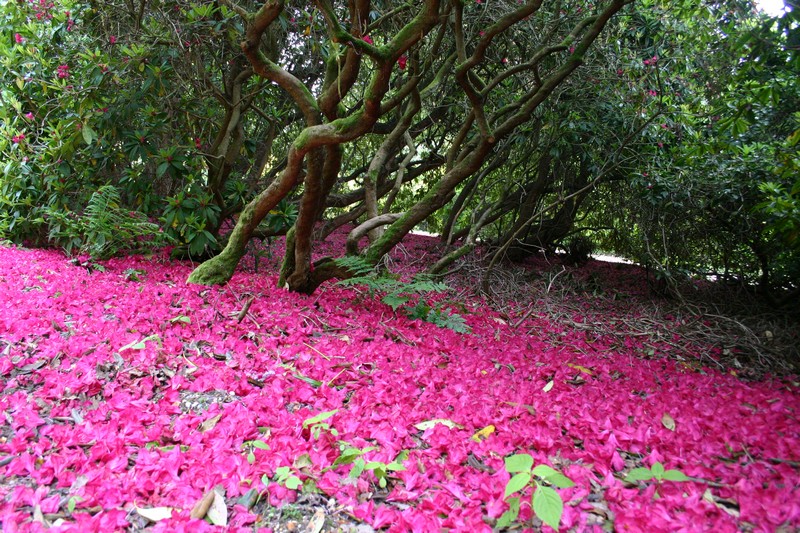 |
| Rhododendron Wood at Leith Hill. |
But back to the bashing...
~
A new day, a new site and a new volunteer
group.
Volunteers from a group formed by the
Windermere Reflections project joined us at Wray Castle. Ornamental
rhododendron can be seen lining the edge of woodland around the Wray estate,
however, invasions further into the woods once again threaten the habitat.
 |
| There's rhody in there somewhere. |
The rhody here were smaller and more
dispersed than at Pate Crag. The difficulty, however, was in getting to them
through the overgrown ferns and brambles.
The site had recently seen some rhody
bashing and piles of dried branches were lying waiting for us to put them on
the fire. Again, luckily, we had a retired fireman amongst us to help manage
the fire. This was important as we had no 'ready made' fire site like the
charcoal burning platforms. Instead we cleared a suitable area of ferns, with
paths to and from the site, where a small controlled fire could be set and
managed.
 |
| Piles of branches from previous visit. |
 |
| Dragging branches though pathways to the fire. |
 |
| Retired fireman Steve managing the fire. |
Like the day before the team worked
efficiently cutting, treating, dragging and burning, despite the hot weather,
until the thunder storm came and we all retreated to the castle for a well
earned cup of tea.
 |
| Rain stops play. |
As the rain subsided we returned to tidy
up and pile the un-burned branches ready for the next visit.
 |
| Stumps treated with pesticide.
The blue dye helps identify which stumps
have been treated.
|
Both sites will need to be revisited on
several more occasions over the coming years before the work is complete. Such
is the ongoing task of Rhody Bashing.
A huge thanks to all the volunteers from
South Lakes Volunteer Group and Windermere Reflections for all their hard work
in taking us one step closer to having rhody-free woodland.


