Showing posts with label Invasive species. Show all posts

24 June 2016

Rhody Bashing on the west shore of Windermere


The woodlands of High Furness have had a long history of charcoal production dating back at least to the 13th century. The 17th century saw an increase in demand for charcoal from the Iron Industry and much of the woodland along the west shore of Windermere was managed for its production up to the mid 19th century.

Charcoal was burned on site in turf mounds situated on charcoal burning platforms or 'pitsteads'.  These were large flat clearings made within the woods, either earthen or stone built. Over 250 of these pitsteads, along with 'collier paths' -  tracks for the transportation of the underwood and charcoal to and from production sites, can still be seen throughout the woods around Claife.

One such wood, Pate Crag Coppice, was a working coppice from at least the 17th century through to the early early 20th. In the years since its coppice stools have grown into impressive multi-stemmed trees. But the woods have also suffered an invasion of rhododendron which now threaten this historic woodland.

A non-native invasive species, rhododendron prevents native flora from growing due to its dense evergreen shade. It colonises an area through stem layering and by producing millions of seeds, and is difficult to remove thanks to its 'tenacity of life', making it the bane of conservationists. 

Much work has been done by the rangers in recent years to remove rhododendron and improve woodland flora and bio-diversity. But the successful eradication of rhododendron requires a programme of managed removal, monitoring and control over a number years - aka Rhody Bashing.
Rhododendron in Pate Crag Coppice.
No rhododendron in Pate Crag Coppice.

As part of Volunteers' Week (1-12 June) a group of 8 members from the South Lakes Volunteer Group joined us on a bright, hot Tuesday morning for a day of Rhody Bashing at Pate Crag Coppice. Led by Richard, our Woodland Ranger, and armed with bow saws, loppers, flapjack and lots of water we set off from the lakeside track over the steep and sometimes slippery terrain of the woods to one of the pitsteads that would serve as our base for the day.

There are several ways to tackle rhododendron. You can pull up the seedlings by the roots, dry the roots and snap the stem; saw off branches at the base and treat the stump with herbicide; spray the leaves with herbicide where there is no risk of over-spray effecting surrounding flora or contaminating a watercourse; or use mechanical flailing.

Given our number and the size of the near by rhodies, plus the steepness of the terrain and potential risk of over-spray, our method of choice was to cut and saw the branches down to the stump. We left about a foot standing with a few leaves sticking up to act as a flag. This is to help locate the stump and treat it with herbicide at a later date. The cut branches were then piled up ready to be burned. Yes, just what you need on a hot, sweaty day with no breeze. A fire. Luckily one of our number was an ex-fireman more than happy to get the fire going.

Volunteer tackling a large rhody stump.

Rhody stump with 'flag' of leaves.

In a manner one can only imagine was similar to those who worked these woods for charcoal in years gone by we formed an effective production line from shrub to fire. One or two small groups where based up slope cutting off branches then lobbing or dragging them down slope to the charcoal platform. Another group cut up the pile of branches into smaller manageable stacks while the final group fed and managed the fire. In this fashion we cleared all the rhody sites we hoped to in good time. 

Where the rhododendron once stood was now an expanse of bare ground. A reminder of just how damaging to the habitat it can be. 

Bare ground where rhododendron once stood.
The fire can be seen down slope in the background.
 
An area of Pate Crag Coppice where the rhody has previously been removed.

Light gets through and new life grows again.

~

Rhododendron ponticum was present in Britain in previous interglacials but didn't re-colonise here in the post-glacial. Native to parts of southern Europe it was (re)introduced to Britain in 1763 and became abundant throughout the 18th and 19th centuries as an ornamental plant and as game cover. It has now widely naturalised. Particularly on acid soils and in shaded woodland.

It damages the habitat it invades by dominating the area. It spreads laterally through branch layering creating its dense, impenetrable growth which prevents light from getting to other species. Its leaves and buds contain toxic chemicals making it unpalatable to grazing animals. These chemicals may also act as an inhibitor to the growth of competing species further adding to its domination. Its honey is poisonous to humans and bees. It can be a host for fungal pathogen Phytophthora.

Where the native flora ceases to be so too do the animals which live off the flora and hence the animals that live of those animals and so on leaving the area virtually barren of all life except the rhododendron. Even in woodland, where trees can exist above its dense shade, no new saplings can seed. So as the existing trees die off only the rhododendron will remain.

Such tenacity makes eradication costly, labour intensive and time consuming. Even after removing existing growth and treating with herbicides the millions of tiny seeds that are produced each year are easily spread far and wide by the wind making regrowth highly likely. A site needs to to be revisited over successive years to repeatedly control the regrowth before the site can be declared free of rhododendron.

Yet, despite all this, in its exotic form the bright flowers and twisted branches can look quite spectacular.
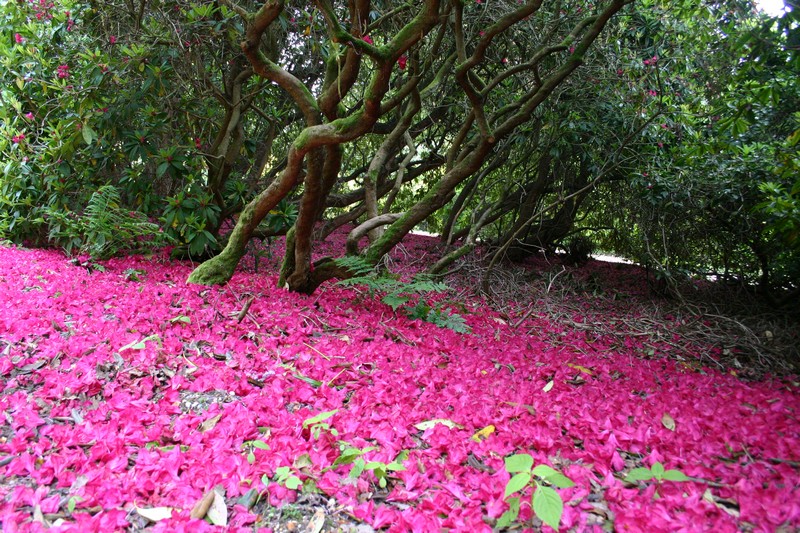
Rhododendron Wood at Leith Hill.

But back to the bashing...

~


A new day, a new site and a new volunteer group.

Volunteers from a group formed by the Windermere Reflections project joined us at Wray Castle. Ornamental rhododendron can be seen lining the edge of woodland around the Wray estate, however, invasions further into the woods once again threaten the habitat.

There's rhody in there somewhere.

The rhody here were smaller and more dispersed than at Pate Crag. The difficulty, however, was in getting to them through the overgrown ferns and brambles.

The site had recently seen some rhody bashing and piles of dried branches were lying waiting for us to put them on the fire. Again, luckily, we had a retired fireman amongst us to help manage the fire. This was important as we had no 'ready made' fire site like the charcoal burning platforms. Instead we cleared a suitable area of ferns, with paths to and from the site, where a small controlled fire could be set and managed.

Piles of branches from previous visit.

Dragging branches though pathways to the fire.

Retired fireman Steve managing the fire.
 
Like the day before the team worked efficiently cutting, treating, dragging and burning, despite the hot weather, until the thunder storm came and we all retreated to the castle for a well earned cup of tea.

Rain stops play.

As the rain subsided we returned to tidy up and pile the un-burned branches ready for the next visit.

Stumps treated with pesticide.
The blue dye helps identify which stumps have been treated.
 
Both sites will need to be revisited on several more occasions over the coming years before the work is complete. Such is the ongoing task of Rhody Bashing.

A huge thanks to all the volunteers from South Lakes Volunteer Group and Windermere Reflections for all their hard work in taking us one step closer to having rhody-free woodland.


27 May 2016

In praise of bluebells


In praise of bluebells

A fine and subtle spirit dwells
In every little flower,
Each one its own sweet feeling breathes
With more or less of power.
There is a silent eloquence
In every wild bluebell
That fills my softened heart with bliss
That words could never tell.

Anne Bronte, 1840.

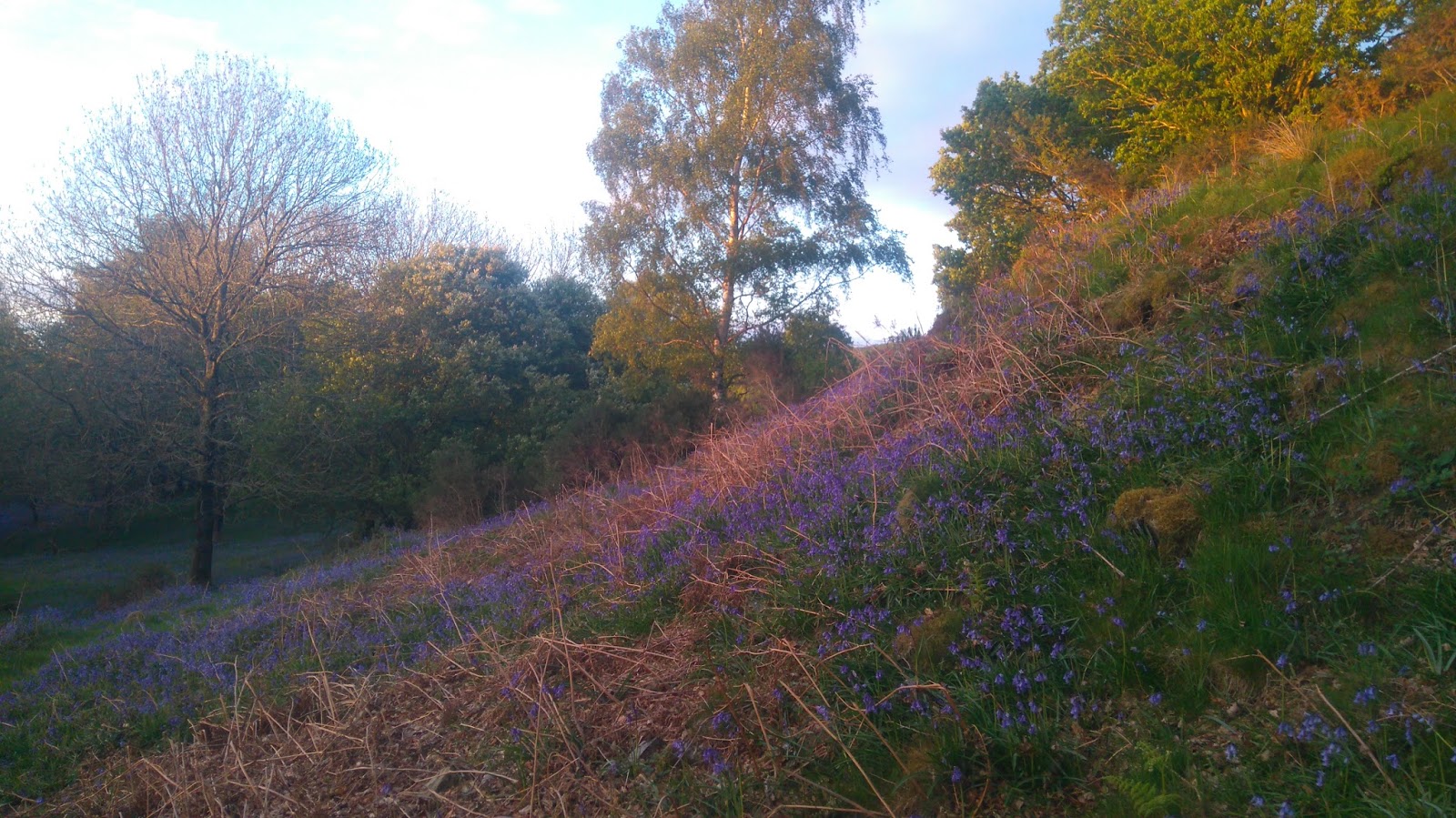
 They’re on the wane now, those carpets of frosted blue, melting back into the woodland floor as the mercury rises and the canopy closes over. Yet for an all-too-brief window every spring, bluebells bring woods all over Britain bursting into life. To many these azure seas of flowers are as emblematic of the returning sun and lengthening days as the call of cuckoos or the sight of swallows. It’s little wonder that our native hyacinthoides non-scripta is amongst the favourite of the nation’s wildflowers. This charismatic, ‘eloquent’ little flower is rich in folklore and history too, and perhaps because they are found in ‘ancient’ woodland, or perhaps because they contain poisonous glycoside compounds, bluebells have long been associated with fairies. Legend has it that the ‘bells’ were rung to summon fairies to gatherings deep in the woods, but should the ringing fall upon a human ear, alas death would soon come upon that unfortunate soul. 
 
A meeting place for fairies?

To witness the spectacle of a bluebell wood in full bloom, whilst hopefully avoiding an untimely demise, there are few better places than here in the Lake District. Bluebells have a preference for oceanic climates, so the UK, and the west coast in particular, with our prevailing weather bringing mild and wet fronts off the Atlantic, creates the perfect growing conditions. In fact, so well suited are they to our climate that the UK is home to around half the world’s population of hyacinthoides non-scripta.

Bluebells also grow best in undisturbed soil, in ground that has remained free from the plough or other intrusions for as long as possible. They tend to take a long time to become established in new habitat, yet this apparent torpidity also means that they can linger long after conditions have changed. Like organic archaeology, to come across an open field of bluebells is to bear witness to a changing landscape, a persisting footprint of a now-vanished habitat. They, along with a handful of other plants, are an indicator of ancient woodland. Ancient in this sense meaning pre- 1600 AD, before maps became widely available and woodland management became commonplace, though some may have lineage that traces all the way back to the most recent ice-age, 10,000 years ago. It’s a rare and shrinking habitat, covering just 2% of the UK’s land surface, though unfortunately it’s rarity often doesn’t equate to value, and many sites remain unprotected in law, at the mercy of human development and exploitation.
Bluebells in open habitat are an indicator of ancient woodland.

Bluebells themselves however, do enjoy a certain level of protection. Although not officially endangered, since 1998 it has been illegal to collect them for sale, and they are further safeguarded from intentional uprooting under the Wildlife and Countryside Act of 1981. The major threats to our native flowers however, come in rather more subtle guises than unscrupulous plant collectors. They first started to appear in the 1960’s, immigrants from Spain escaping from confinement in gardens and parks. Over the following decades increasing amounts of this modern-day Spanish armada has appeared in our woodlands. More robust, more adaptable, and more vigorous than UK bluebells, hyacinthoides hispanica will out-compete native flowers wherever they gain a foothold. To further cloud the picture the two species will readily interbreed, producing a hybridized variety with characteristics of both, and which could ultimately lead to the loss of the genetically distinct non-scripta species. Ominously, in a recent survey by the charity Plantlife, it was found that one in six bluebell woods contained either Spanish or hybrid bluebells alongside native UK plants.

Recognising the three varieties of bluebell now encountered in the UK woodlands (image reproduced courtesy of Cumbria Wildlife.org).

Yet it is it is a different threat which represents the most uncertain future for our beloved bluebells. Native seeds can and are being banked. Spanish invaders can to an extent be eradicated (though it is illegal to uproot any plant without landowner consent). A changing climate however, could see bluebell carpets disappear into memory as the ecological niche to which they are so superbly adapted is swallowed up by shifting patterns and seasons.  If the trend for earlier springs continues, the advancing overhead canopy and competition from other plants on the woodland floor could close the window on bluebells forever.
Could sights like this become a thing of the past?

I for one hope not. I hope that the spectacle of a bluebell wood in full bloom, surely one of the most delightful and uplifting treasures of the British countryside, is around for many years to come. I hope that future generations can experience and wonder at their subtle majesty, and fill their own softened hearts with bliss as they do so.

6 September 2013

My shameful secret !


I’ve got an embarrassing and shameful secret, something I’ve been keeping from my friends and work colleagues. Something that a Countryside Ranger , of all people should be in control of. I think they suspect   ; there ‘s been strange looks in the corridor and conversations cut short as I walk into the room.
It’s something I thought I could deal with myself in private without outside help . I thought that was the best way , I thought I was strong enough.... I was wrong.

First it was just one then it was more than one and before I knew it , it was out of control. I don’t want you to think that I did nothing , I did try ... god knows I tried, I put hours in trying to stop it , last year I thought I’d got on top of it , I got cocky I suppose and that ‘s when it really took hold .

Well it’s time I faced my demons and came clean , so that you don’t  have to go through what I’ve been through , the skeleton in my cupboard, the shameful secret I’ve been trying to hide is   ......Himalayan balsam   it’s all over the bottom of the garden thousands of massive  plants with pink blousy flowers and then tens of thousands of seeds. There I’ve said it , and I feel much better now  that I’ve got it off my chest.


It’s a plant that is familiar in the British countryside introduced in 1839  by well meaning and curious Victorians they thought this exotic heavily perfumed pink flowering  plant  originally from the Himalayan mountains would look good in the garden . It did indeed look good in the garden but unfortunately it didn’t stay there ! This aggressively mobile plant has spring loaded seed cases that can fling the seed several metres and it thrives in almost any soil type . This means that it can ‘walk’ out of gardens  , along railway lines and down river banks where it grows in balsam stands,  tens of thousands strong out competing our native flora , by shading it out and taking its moisture.


For the last few years the National Trust ,  with hundreds of volunteers has been trying to eradicate this invasive species from our land in the Windermere catchment . We have been quite successful, I myself have lead volunteer groups pulling  balsam plants up by the roots . This makes my garden , one of the few remaining Himalayan balsam refuges on Trust land around Lake Windermere, something as I mentioned that is a bit embarrassing and not something I’m proud of . I have spent hours in the garden ,last year and this , pulling the plant up , but once the bracken has fallen over it forms a protective layer under which the balsam grows eventually poking its head up into the light to flower and seed . I am now involved in guerrilla warfare with it,  waiting for it to show itself and then pouncing on it and pulling it out or cutting the heads off it. It’s a battle that I think I am slowly winning now, I’ll find out for sure next year. 

Terminator vs. Mr Bean

If Himalayan balsam is  ‘ The Terminator’ of the plant world , an aggressive survivor that simply can not be stopped , then the touch- me- not balsam , our only native balsam  , is a bit more  ‘Mr Bean’.  It’s a nationally scarce plant found in the Lake District and North Wales, with an attractive yellow flower. The plant generally grows in small numbers in damp glades in woodlands and appears to be demanding in terms of light and moisture, it requires ground disturbance to spread. Balsam stands will grow and spread and then for no obvious reason ; disappear . We are lucky to have a good number of these balsam stands on our property in the south lakes  and now is a good time to find them in our woods . 


This unpredictable plant is also special because it plays host to a very scarce moth ,the caterpillars of the Netted Carpet moth, rely solely on this plant for their food . So the future of one is tied inextricably to the survival of the other. 


This is why at this time of year we are to be found on our hands and knees inspecting the underside of  leaves , looking for the small green caterpillars that will eventually become netted carpet moths. A job not made easier by the fact that the caterpillar is camouflaged and looks exactly like the seed pod and stem of the plant ! 


 As a result of some careful management  , grazing with cattle in some of our woods and  the spreading of seed , the number of plants  and moths are increasing . A significant success story for our native flora and fauna.

Paul Farrington
National Trust Ranger ( South Lakes )

6 July 2012

The aliens have landed - you don't want to know where ....

A lot of the jobs we tackle can only be done at certain times of the year and it’s about this time of year that Himalayan Balsam starts to rear it’s deceptively pretty head. You’ll probably have seen it, growing alongside a road or river. Maybe you’ve even thought how attractive its large pink flowers look. But it’s one the most aggressive invaders of our countryside, becoming an increasingly familiar sight alongside our roads and streams as it spreads by seeds being carried along watercourses.

A fine example of a balsam plant, but too early for pink flowers

Luckily, it can be pulled out of the ground quite easily and unlike some other invasive species (Japanese knotweed for example) it won’t regenerate from a tiny sliver of plant left behind. Although this type of work can be dispiriting for a couple of members of staff to tackle on their own, a big gang of volunteers can make an enormous difference in one day. And big gangs of volunteers is what we do well here at Basecamp!


CDOT at the farm with some of the removed piles of plants

There’s a relatively short window of time to get it: it needs to be big enough to identify but not so big that the seed heads have matured. When they have, they pop with impressively explosive force when touched, spreading more seeds. We also need to make sure we tackle it in the right places - if there’s more left upstream those exploding seed heads will quickly send reinforcements down to repopulate a cleared area. 


So, along with the Cumbria Freshwater Invasive Non-Native Species (CFINNS) Initiative – a county wide scheme helping to coordinate many organisations and put together the bigger picture of where the balsam is growing on different landowners land – we’ve been out with our volunteer groups clearing a couple of ‘motherlodes’ of balsam at the tops of watercourses.

The South Lakes group in the sewage works
Unfortunately this has lead us to some decidedly unglamorous places. A first trip out with the South Lakes Conservation Group to an old united utilities sewage works was smelly enough. However, we’ve continued that theme this week with a visit to a farm with CDOT (Community Drugs Outreach Trust) where the balsam was growing in a massive heap of manure!


Behind you!
At the end of these days though we’d done some great work to really knock the plant back. And if that means we see a few less of those pink flowers it makes it all worthwhile!

By Rob Clarke, Community Ranger at High Wray Basecamp