Showing posts with label Lake District. Show all posts

27 May 2016

In praise of bluebells


In praise of bluebells

A fine and subtle spirit dwells
In every little flower,
Each one its own sweet feeling breathes
With more or less of power.
There is a silent eloquence
In every wild bluebell
That fills my softened heart with bliss
That words could never tell.

Anne Bronte, 1840.

 They’re on the wane now, those carpets of frosted blue, melting back into the woodland floor as the mercury rises and the canopy closes over. Yet for an all-too-brief window every spring, bluebells bring woods all over Britain bursting into life. To many these azure seas of flowers are as emblematic of the returning sun and lengthening days as the call of cuckoos or the sight of swallows. It’s little wonder that our native hyacinthoides non-scripta is amongst the favourite of the nation’s wildflowers. This charismatic, ‘eloquent’ little flower is rich in folklore and history too, and perhaps because they are found in ‘ancient’ woodland, or perhaps because they contain poisonous glycoside compounds, bluebells have long been associated with fairies. Legend has it that the ‘bells’ were rung to summon fairies to gatherings deep in the woods, but should the ringing fall upon a human ear, alas death would soon come upon that unfortunate soul. 
 
A meeting place for fairies?

To witness the spectacle of a bluebell wood in full bloom, whilst hopefully avoiding an untimely demise, there are few better places than here in the Lake District. Bluebells have a preference for oceanic climates, so the UK, and the west coast in particular, with our prevailing weather bringing mild and wet fronts off the Atlantic, creates the perfect growing conditions. In fact, so well suited are they to our climate that the UK is home to around half the world’s population of hyacinthoides non-scripta.

Bluebells also grow best in undisturbed soil, in ground that has remained free from the plough or other intrusions for as long as possible. They tend to take a long time to become established in new habitat, yet this apparent torpidity also means that they can linger long after conditions have changed. Like organic archaeology, to come across an open field of bluebells is to bear witness to a changing landscape, a persisting footprint of a now-vanished habitat. They, along with a handful of other plants, are an indicator of ancient woodland. Ancient in this sense meaning pre- 1600 AD, before maps became widely available and woodland management became commonplace, though some may have lineage that traces all the way back to the most recent ice-age, 10,000 years ago. It’s a rare and shrinking habitat, covering just 2% of the UK’s land surface, though unfortunately it’s rarity often doesn’t equate to value, and many sites remain unprotected in law, at the mercy of human development and exploitation.
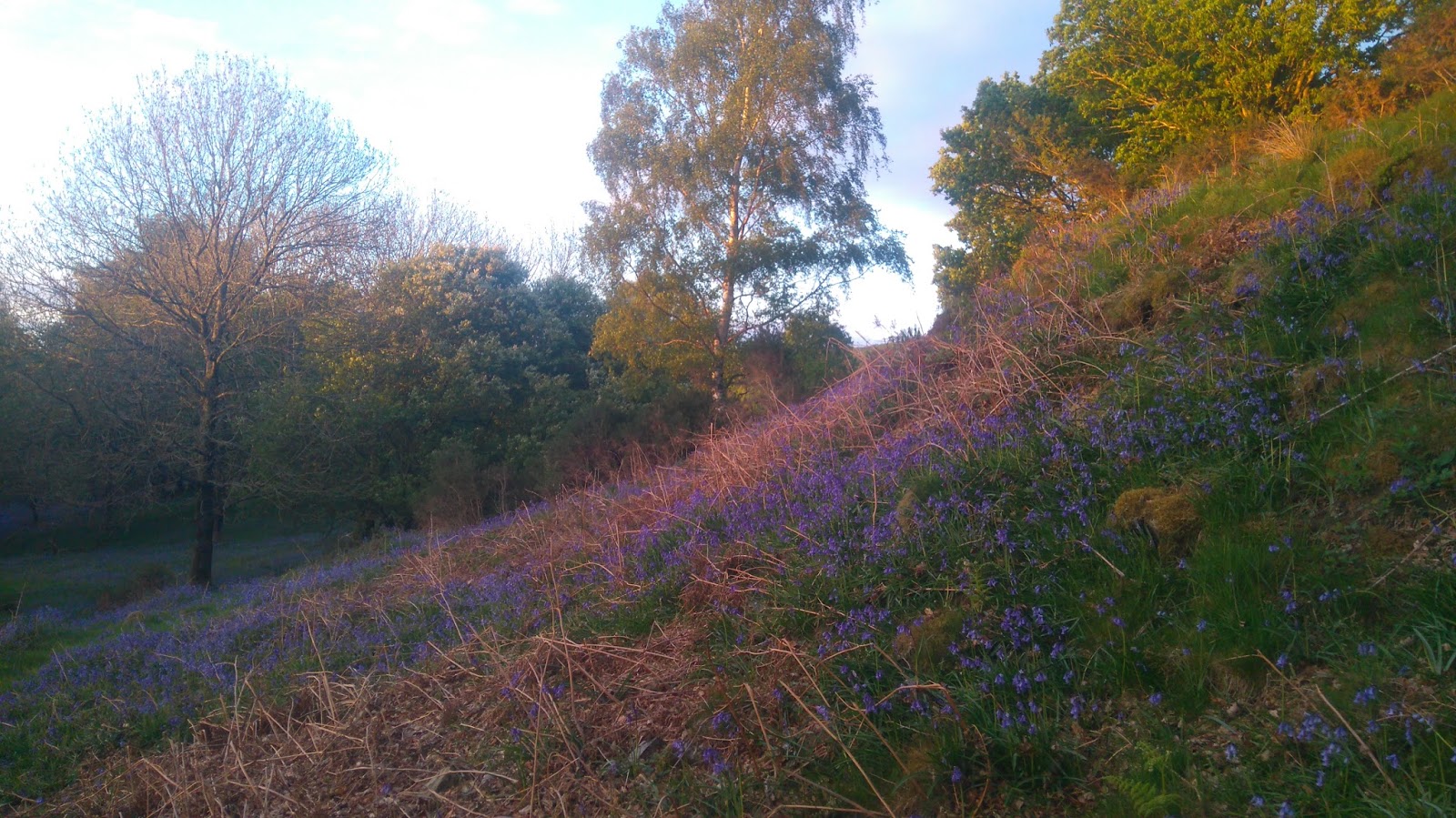
Bluebells in open habitat are an indicator of ancient woodland.

Bluebells themselves however, do enjoy a certain level of protection. Although not officially endangered, since 1998 it has been illegal to collect them for sale, and they are further safeguarded from intentional uprooting under the Wildlife and Countryside Act of 1981. The major threats to our native flowers however, come in rather more subtle guises than unscrupulous plant collectors. They first started to appear in the 1960’s, immigrants from Spain escaping from confinement in gardens and parks. Over the following decades increasing amounts of this modern-day Spanish armada has appeared in our woodlands. More robust, more adaptable, and more vigorous than UK bluebells, hyacinthoides hispanica will out-compete native flowers wherever they gain a foothold. To further cloud the picture the two species will readily interbreed, producing a hybridized variety with characteristics of both, and which could ultimately lead to the loss of the genetically distinct non-scripta species. Ominously, in a recent survey by the charity Plantlife, it was found that one in six bluebell woods contained either Spanish or hybrid bluebells alongside native UK plants.

Recognising the three varieties of bluebell now encountered in the UK woodlands (image reproduced courtesy of Cumbria Wildlife.org).

Yet it is it is a different threat which represents the most uncertain future for our beloved bluebells. Native seeds can and are being banked. Spanish invaders can to an extent be eradicated (though it is illegal to uproot any plant without landowner consent). A changing climate however, could see bluebell carpets disappear into memory as the ecological niche to which they are so superbly adapted is swallowed up by shifting patterns and seasons.  If the trend for earlier springs continues, the advancing overhead canopy and competition from other plants on the woodland floor could close the window on bluebells forever.
Could sights like this become a thing of the past?

I for one hope not. I hope that the spectacle of a bluebell wood in full bloom, surely one of the most delightful and uplifting treasures of the British countryside, is around for many years to come. I hope that future generations can experience and wonder at their subtle majesty, and fill their own softened hearts with bliss as they do so.

17 December 2015

Black Eye Friday


Black Eye Friday

Around here the Friday before Christmas is traditionally known , by the emergency services, as ‘Black Eye Friday’  it’s the day when the local builders, joiners, plumbers, electricians and people who work the land,  finish work and start their Christmas break . Many local trades people gather  in the local pubs , much drink is taken , tongues are loosened and later in the evening petty rivalries and grievances are aired,  things are said that would be better left unsaid leading to the inevitable ‘wrestling and fisticuffs ‘ and the blackening of eyes !


Lake Windermere just kept on rising


This year however may be a bit different , the recent exceptionally severe flooding and strong winds has meant that houses have been flooded , roads and bridges damaged,  trees felled onto tracks and paths , walls and fences.


Multiple windblown trees across this track on Claife !


Some of our National Trust staff have been affected;  flooded out of  their houses, possessions damaged beyond repair. 


Flooded properties at Strawberry Gardens.


Like our own NT Rangers , many of the local builders are now busier than they have been all year , working hard to repair the damage caused by wind and water, hoping to get people back into their homes before Christmas .


 As I write this we have Rangers and teams of volunteers assessing and prioritising the damage , repairing tracks  and removing windblown trees from paths. Builders  and joiners are delaying their Christmas break ripping out damaged kitchen units and furniture trying to dry out properties quickly so that re-building work can begin. This work will continue well into the new year and some of it will take months !


Cumbrian Spirit

All this paints a bleak picture,  but the reality of life in the Lakes is that we have faced severe weather challenges before; repaired, rebuilt and carried on with our work and our lives and this time will be no different. Most of the businesses are open as usual , the majority of roads and bridges are open , the countryside is accessible , if a little scarred in places .


Moody and magnificent
So come and visit Cumbria and the South Lakes we are open for business and we could do with your support now more than ever. If anything the Lakes is looking even more moody and magnificent , the becks and waterfalls are certainly something to behold,  and Christmas is a great time to be in the Lakes whatever the weather !


Please note : Do check our NT website for opening times  and info as some of our properties close for a Winter break to prepare for the new season.

Happy Christmas

4 September 2015

Crest is Best

This week's countryside blog comes from the Upland Ranger team based in the South Lakes area. 

"Crest is best" is a catchy little phrase that was introduced to the team recently by Richard Fox, Fix the Fells Ranger for the Lake District National Park Authority. This phrase nicely sums up the approach we would ideally like walkers to take on two upland paths that we have been working on over the last few years.

The projects in question are Swirral Edge and Striding Edge, two iconic routes to the summit of Helvellyn. These have been joint projects and we have worked alongside both the Western and Northern teams.

The main year for the work on Swirral Edge was 2013, although we have been back each subsequent year to continue the work.

 
April 2013: On route to fill heli-bags with rock for the Swirral Edge project
April 2013: Western team looking down at Swirral Edge
  Will the snow clear in time to start the project......
April 2013: The snow did clear in time - helicopter lifting rock to Swirral Edge
"Squirrel over Swirral"
On Striding Edge we started the actual project work in 2014. We continued the work this year and currently expect to return each year to carry out further work.

June 2013: Initial visit to Striding Edge to plan project for following year
April 2014: Waiting on Helvellyn & hoping the cloud will lift .........

.....it was worth the wait. Helicopter now moving rock to site for Striding Edge project
The key reason for the work we have been doing on these sites is erosion, the underlying problem that drives all of the work the upland teams do.  The erosion is damaging to the upland habitats and also unsightly. In addition material that gets washed down into the lakes and rivers below is damaging to those habitats.

The focus of our work has been some particularly bad areas of erosion that had developed on the sides of Swirral and Striding edges and also multiple routes on Helvellyn headwall at the end of Striding Edge.  These areas had been deteriorating with some becoming very unstable. In places these routes also seem more difficult or dangerous to negotiate than the actual arêtes.

Our challenge has been to stabilize the ground and prevent further erosion and hopefully give these upland areas a chance to recover. 

We have used several techniques which have included using additional rock to stabilize parts and to disguise side routes.  We also carried out work to make any preferred routes clearer and easier to follow to try to stop walkers straying into problem areas. 
June 2013: Working on side route erosion on Swirral Edge with the Western team
August 2014: Working on Helvellyn head wall with the Western team
June 2015: Working on Helvellyn head wall with the Northern team
Various other landscaping techniques have also been used to remove side route erosion along with specially mixed grass seed to help the vegetation recover and stop further erosion. 
BEFORE: Section of side route on Striding Edge with work in progress....
AFTER: Striding Edge side route section after re-profiling & turfing
In summary, we believe that “Crest is Best” for a number of reasons, including:
-  the crest is rock and can withstand the repeated footfall of many visitors without an erosion problem occurring
-  the erosion is both damaging to the upland habitat and the lakes and rivers below
-  the sides routes aren’t necessarily safer as they are unstable and, in our experience, some of these routes are more challenging/dangerous than following the arête
-  there are rare flora in places on these edges and on Helvellyn headwall; the more people spread out the greater the potential damage to these

Based on the team's experiences, if people want to enjoy walking Striding or Swirral edges we suggest choosing the day carefully.  They are not nice places to be on wet and/or windy days and, even though we know the edges quite well, we would save the challenge for another day.

These projects have become favourites for some of the team members, the locations can be very atmospheric. To conclude this blog here are a few favourite Striding Edge images:


If you would like to know more about the daily work of the South Lakes Upland Ranger team they can be found on Twitter @NTLakesFells or for more about Fix the Fells follow this link: Fix the Fells 

Posted by: Nick, Upland Ranger

17 July 2015

Tree TV - for tree geeks everywhere

It's no secret to anyone here at South Lakes that I really, really love the rare small leaved lime trees hidden away in Coniston's gills. These beautiful trees are a direct link to the pre-human 'wildwood' - read more in my old blog post here.

Recently I had the chance to share my love for lime in a different format when Rob, our community ranger, made this atmospheric film one sunny summer's day. Naturally it's mortifying to watch myself on screen but it's great to get the message out about these time-travelling trees. Thanks Rob!


6 March 2015

100 working holidays and counting .....


Working holidays are a great way to get involved with the National Trust’s work and some people return many times to take part in them. Some go that extra mile though and Di Lang is a great example of this. A long standing working holiday leader (the leader is not staff but takes charge or housekeeping, shopping, menus etc), Di led her first holiday here at High Wray back in 2004 and recently returned here to lead her 100th!

Di (left) on the 100th holiday

Di has led holidays as diverse as Drystone walling and hedgelaying, woodland management and running events. We’re particularly thankful for her formidable organisational skills and boundless enthusiasm in leading our upland adventure holidays, where participants camp out on the high fells for three nights and work to reduce path erosion in the day.

‘I’m from a farming background’ Di says ‘I always used to be out with my Father when I was growing up. My career took me on a different path, running my own flooring business, but one day I noticed a hedge by the side of the road. ‘That’s a well laid hedge’ I thought, then thought ‘that’s my father talking’. So I went to agricultural college and did a few short courses, then looked into conservation holidays and found the National Trust’s Working Holidays and I’ve stuck with them ever since.’

So what is it about Working Holidays that keeps Di coming back for more? ‘The variety, the places you go to and the people you meet. I love the extra knowledge you learn as I think your brain is still a muscle that needs working. It keeps your body moving as well! I enjoy the social elements too, meeting new people and some of their experiences and backgrounds are amazing. No working holiday is exactly the same either, you may come back to the same Basecamp but the dynamics of the group are completely different.’

‘The High camp ones are really special to me and I love footpath laying too. I’m off to do scything this year, because we’ve got a grassland area close to where we live and we want to turn it into a wildflower meadow. It’s new skills again. I’ve discovered I’m not really a gardener though – it’s too tidy!’

On the fells on a camping holiday
Floored!
To cap it all, to mark the 100th holiday Di stayed on a week at the end of it and with the help of ever supportive husband Max brought her flooring skills to bear by replacing our tatty old vinyl floors with a new hard wearing surface. This looks great and should last for years to come

‘I sort of think of High Wray as a second home now and when I was here another time I was looking at the floors and thinking I could put a new floor down to make it more attractive for people to come here. You get a pride in your work when you’re doing something like this and it’s nice to think that other working holidays and volunteer groups will get the benefit of this in the future.’

Di reclines on the newly fitted and very smart floor in the 'Acland' block, with 100th working Holiday presentation picture
We’re looking forward to many more years of working alongside Di, with another camping holiday scheduled for this May. It’s thanks to the dedication and hard work of leaders like Di (and there are plenty of others too) that the National Trust is able to offer such a varied and interesting working holiday programme, enabling many people to get involved with our work and help us look after our special places for everyone.

We’ll leave the last word to Di:

‘I’ll be carrying on with working holidays as long as I can, I’ve no intention of giving up. I still get excited every year when the new brochure comes out and I’m straight in there looking at where working holidays can take me this year.’

Rob Clarke, Basecamp Community Ranger

Find out more about National Trust working holidays here:

30 January 2015

An Upland Rangers Sack...


We Upland folk have to be ready for anything, one day we could be doing habitat creation close to home, the next up on the high fells with an unexpected storm blowing through.  Granted we are pretty wise to where we go, especially in the winter months, but even in the summer the high fells can be a pretty unforgiving place to be as weather can, and does change very quickly!

Lovely day in the valleys, snowy on top!
As such our rucksack could be described as somewhat weightier that any of our low land colleagues.  Indeed if anyone else picks up our rucksacks it’s normally followed with a ‘Blimey!  What on earth have you got in there?!’  So when this question was posed quite recently I preceded to answer in great detail by emptying my bag....

Ta daaaa
But this got me thinking about all the weird and wonderful things that we do end up carrying up or off the fell. To start with we have the obvious as seen above, waterproofs, food, water, hot flask, first aid kit, spare jacket, map, whistle, compass, gloves.  These are the basics that keep us safe and comfortable when out working; alas to do work we need some tools…

Tools tools wonderful tools


The rock carrier (an Icelandic concept!)


Power Barrow, rock hammer.....
A rock hammer I hear you say?!  Yep and very useful it was too, I’m just glad it wasn’t me that had to carry it!  The power barrow meanwhile would have been driven up and although a little unwieldy at times does make moving lots of material much easier.  Another useful tool for this is our good friend the winch, but again, with a wire cable, winch body, handle and strops to be brought up it is most definitely a team effort.
Winching a rather large stone
Winching is immensely useful, especially on small projects.  But when it comes to larger projects that need a lot of stone, helicopters are, oddly enough, the most environmentally friendly way to move stone onto site.  But for this to happen stone has to be hand selected and placed into large black dumpy type bags ready for the helicopter to whisk away and onto site.  Again, these big black bags don’t walk to site by themselves!  Typically we’ll each carry 8-10 bags up onto site, which will each get filled with around 700-900kg of stone.
Carrying the Heli Bags....
...ready to fill them with stone!
Some stones however are a bit more controversial and it is often with mixed feelings that we find ourselves carrying them off the fell.  These are memorial stones and can vary from little plaques to chunks of slate.  We carry them off on the basis that if we leave them it could be seen acceptable to place memorials out on the fells.  This could result in fell tops, view points and summit cairns becoming littered with said memorials, not exactly what you’d expect to see when out on the fells.
Ah cake! Another very important piece of luggage
This all sounds like hard work doesn’t it, so I guess we should look at the comfort side of things, it’s important to take it easy every now and again!  Come forth the shed.  A beacon of hope on wild days, but also somewhere to store the deck chairs for sunny days and our own personal kitchen…  
Relaxing by the shed

Pancakes!
Equally it can be quite an odd thing to see on the fells so in some spots we do take to trying to camouflage it into the fells.
Now im sure there a shed here somewhere...
Staying on the relaxed theme our rucksack have one final and probably the most useful function of all, a pillow for that quick lunch time snooze!

ZZZZzzzzzzzzzz
Written by Upland Ranger Sarah
Follow us on Twitter @ntlakesfells