Showing posts with label High Wray Basecamp. Show all posts

15 April 2016

Moving on with the year


With the weather starting to improve now and more groups arriving the team here at the volunteer centre High Wray Basecamp is starting to spend more time outdoors now. We always look forward to this but with the miserable weather we had to put up with over winter we are sometimes quite pleased that we scale back on the amount of time we spend outdoors over the darker months. There are very good reasons for this as there is lots of wrapping up to do of the year just gone, planning to do for the year ahead and more importantly, maintenance of the site itself.


Preparing the walls for repainting, goodbye to gloomy Terracotta
Getting the new Pistachio colour scheme on - sophisticated!

This maintenance occuppied us fully for a couple of weeks as we once more hosted the ‘Basecamp Blitz’, a week long barney of painting and DIY. Being a volunteer centre, we didn't do this on our own and had the help of some very hard working volunteers keen to get going with brush and roller.
Do you like what we've done with the place? The Longland with the first coat on

Now all we need is the roulette wheel - The 'Casino Brown' in full force
Once the walls were complete, we moved on to the floors and laid new carpet tiles down in the Longland block. The old ones were starting to wear out and had so many corners peeling up it was becoming a full time job sticking them back down again. It’s great to have replaced them, even if the new ones have the perhaps inappropriate colour name of 'Casino Brown'!


Now complete we have a lovely fresh feeling to welcome our many groups in for this year - it is a nice thought that improvements that will benefit many volunteers over the coming years have been wrought by volunteers themselves. 
 
But it wasn't all indoor work over the winter and early spring. Part of the aforementioned planning  involved heading up to the hills to look at some of our upland footpath jobs for the year ahead. We got lucky with a rare sunny day for a site visit to Gummer’s How, above Windermere, but weren’t so lucky with a trip up Far Easedale a week later where it seemed winter had returned with a vengeance. Whatever the weather these trips are important as we need to have a very clear idea of the jobs we’ll be tackling with volunteer groups – it’s no good arriving on site and then trying to work out how to tackle a problem when you have 15 volunteers keen to get cracking!

Lucky! The view from the top of Gummers How

Not so lucky! Chilly and wet conditions for the trip up Far Easedale
Since I wrote the most of this blog we've been out tackling the dreaded job of bag filling. Working with the South Lakes upland path team and the Fix the Fells lengthsmen we've been helping each other collecting enough stone for this year’s scheduled upland jobs. The stone is loaded into 1 ton bags ready to be lifted into place by helicopter, always a daunting proposition that we’re pleased to have completed. Finishing this normally coincides with the improvement of the weather and a full move from planning to action, a time of year that can’t come soon enough!


See, it is fun! the lengthsmen mid stone collection


28 August 2015

Give peas a chance ..... Growing ambition at High Wray Basecamp

Here at High Wray Basecamp our mission is to help as many different people as we can to engage with and care for the beautiful South Lakes countryside. We welcome people from all walks of life to stay, and many of them join us in carrying out the vital conservation work that keeps the landscape looking the way it does. We feel that we’re in a pretty good position then, with our wide (and somewhat captive!) audience, to help spread the word about issues affecting the countryside and the wider environment.

With this in mind, towards the end of last year, we started thinking about a Basecamp garden.  It was an idea that had been in gestation for a while, and a previous half-hearted attempt had at least gone some way to addressing the issue of what to do with food waste. But the ‘dalek’ style composters and the overgrown, fenced-off area they inhabited was unsightly and inefficient. We needed something more in keeping with the environs, and the Basecamp ethos.

So plans were drawn up for a garden area that would have multi-functional purposes. First of all it would have a properly constructed and positioned composting area, to deal effectively with food waste generated on site, and to provide compost for our vegetable beds, in which would be grown crops for the benefit of people staying at Basecamp. There would be a small herb garden, again for the use of Basecamp residents. Then there would be a wilder area planted with native wildflowers and flowering shrubs beneficial for pollinators such as bees and butterflies. A ‘bug hotel’ would also be installed to give local invertebrates a helping hand. We also decided to utilise water draining off one of the paths to create a boggy area, and to plant an apple tree, for both blossom in the spring and fruit in the autumn.  The whole area would need to be fenced to keep marauding ruminants at bay, and, true to the Basecamp philosophy, we’d put up an interpretation board to let people know what was going on. All this on little or no budget!

The old garden, with old 'Dalek' and 'Tombola' style composters
Volunteers from 'Mind' in Barrow getting to grips with removing the old fence posts

After returning from the Christmas and New Year break we set about turning these plans into reality. As Basecamp would be nothing without its volunteers, we enlisted the help of some of our regular groups to help us dismantle the old ‘garden’ and start constructing the new composters. We used wood and chicken wire salvaged from the timber yard at Boon Crag to make three adjacent units, large and airy enough to accommodate not just food waste, but grass clippings and some woody material, to provide a more balanced compost.


Volunteers from Littledale Hall Therapeutic Community building the new compost bins


The next stage was to build the raised beds. For these we used wood from NT trees, kindly donated by the forestry team. This was a laborious process, not least because the site was on a fairly significant slope which meant that the beds had to be dug in and levelled.  We were lucky to have lots of willing volunteers to help us with this, and with the arduous task of moving a few tons of leftover topsoil from Claife Station to fill them. Once the beds were done and the site was landscaped to allow for the natural slope (resulting in a rather pleasant ‘terraced’ effect we think), we could get on with the exciting task of actually planting stuff. This year we’ve been planting smaller amounts of veg as a kind of test run, but we still managed to plant some spuds, courgettes, spinach, broccoli, peas and beans. We’re using four, fairly large, separate vegetable beds so that we can rotate the crops and minimise the chances of disease taking hold, and we selected varieties that we reckon are going to be hardy enough to withstand the sometimes harsh Basecamp climate.

The garden completed, but looking a bit bare
We then  sowed our wildflower ‘meadow’ with seeds kindly donated by organisations such as the Bumblebee Conservation Trust and Butterfly Conservation, who do sterling work in addressing the issues faced by these vital pollinators, such as drastic reductions in recent decades of proper meadows. In the middle we planted our showpiece apple tree, a hardy dwarf variety carefully selected for us by the head gardener at neighbouring property Sizergh Castle. We also included some gooseberry bushes gifted by gardener Pete from Beatrix Potter’s Hill Top.

The nascent herb garden

In opposite corners we built the herb garden and the boggy area. The first of these was raised at an angle as a rockery, to take maximum advantage of the sun and to provide as much drainage as possible. In it were planted herbs which could be used by visiting groups in their cooking, such as thyme, rosemary, and sage. It’s a happy coincidence too, that most of the plants in this area are also great for pollinating insects. The boggy area is fed by a drain which collects water off one of the paths, meaning that in the wet Lakeland climate it is continually replenished, and hopefully in due course will provide some good habitat for water-loving creatures such as frogs.
All that was left then was to gravel the paths around the garden, secure the perimeter fence to keep out the deer and stray sheep which occasionally find themselves in the Basecamp grounds, and construct the bug hotel. This was made from old pallets and materials found around the place, and topped with a ‘green’ roof planted with low growing sedum, to blend in with its surroundings and provide further food sources for invertebrates.

Much greener! The wild flower area on the left with apple tree and raised beds on the right


It’s still early days, the garden’s only really been finished a couple of months, and there’s an interpretation board yet to go in to explain everything, but we’re really happy with the results so far, particularly as we had a very slow start to summer up here.  We harvested the potatoes just last week and most of the other veg is coming along as well. We hope to have more next year, but it’s looking like there should at least be plenty of spinach and hopefully even runner beans for our residents (and maybe even ourselves!)  this year. There’s also quite a few wildflowers emerging, in amongst the inevitable weeds that were lying dormant in the soil (Perhaps an autumn weeding job for one of our groups!) 

First of many? this years small potato harvest

Massive thanks then, to all the volunteers and people who donated their time and resources to help us make the Basecamp garden dream a reality. We genuinely couldn’t have done it without you. As the garden matures and develops over time, we hope that it will provide a haven for wildlife, and all the Basecamp visitors, for many years to come.

By Matt Tweed, Basecamp assistant ranger


10 July 2015

Bat Man visits Basecamp!

Up here at the volunteer centre we’re proud of the work we do to help look after our special places. But for many groups a stay here involves a lot more than just working with us as there’s plenty to discover in and around our grounds.

So it was that during a recent visit by Glenburn Sports College the word was out amongst the students that Tuesday evening we were due a visit from ‘the Bat Man.’ Not the punchy kicky superhero (no need for that kind of behaviour at Basecamp), but our regional Wildlife and Countryside Advisor, John Hooson, who had kindly given up his evening to come here and talk about our resident bats.


Bat box on the Longland toilet block roof - you'd never guess there's been 190 bats counted coming out of here!

We have, we think, two colonies of Soprano Pipistrelles (Pipistrellus pygmaeus) at High Wray. We normally let groups know about them and have a couple of bat detectors that we lend out, but having John up here to talk to them added an extra level of interest, especially when he brought out his collection of desiccated bats picked up from various sites over the years! He even had a bat skeleton, where you could clearly see the very similar bone structure in their arms to us – they have an elbow and a forearm with four very long fingers on it which the wing is stretched between and even a little thumb.
 
They're tiny! Getting hands on
The bat skeleton with long finger bones clearly (but slightly blurrily) visible
Blowing raspberries

After a ‘bat chat’ full of interesting facts (Did you know bats aren’t blind, they actually have quite good eyesight?) it was getting gloomy enough to turn the detectors on. These clever little devices ‘listen’ for the bats’ high frequency hunting calls and convert the sound to a lower frequency audible to our ears. It wasn’t too long before we started hearing the bats fluttering past us, catching midges on the wing. On occasion we even picked up the ‘raspberry’ sound they make when they are closing in on an insect and intensify their calls.


After a fascinating couple of hours John departed in the Bat Mobile (might have been a Nissan), but the group were enthused enough that they asked to hold on to the detectors for the next night. No trace remained of the Bat Man, except for one thing – we now have our own example of Pipistrelle, which we plan to show to other groups in the future and hopefully spark off an interest in these amazing creatures.
The 'Basecamp Bat' 

By Rob Clarke, Basecamp Community Ranger

24 April 2015

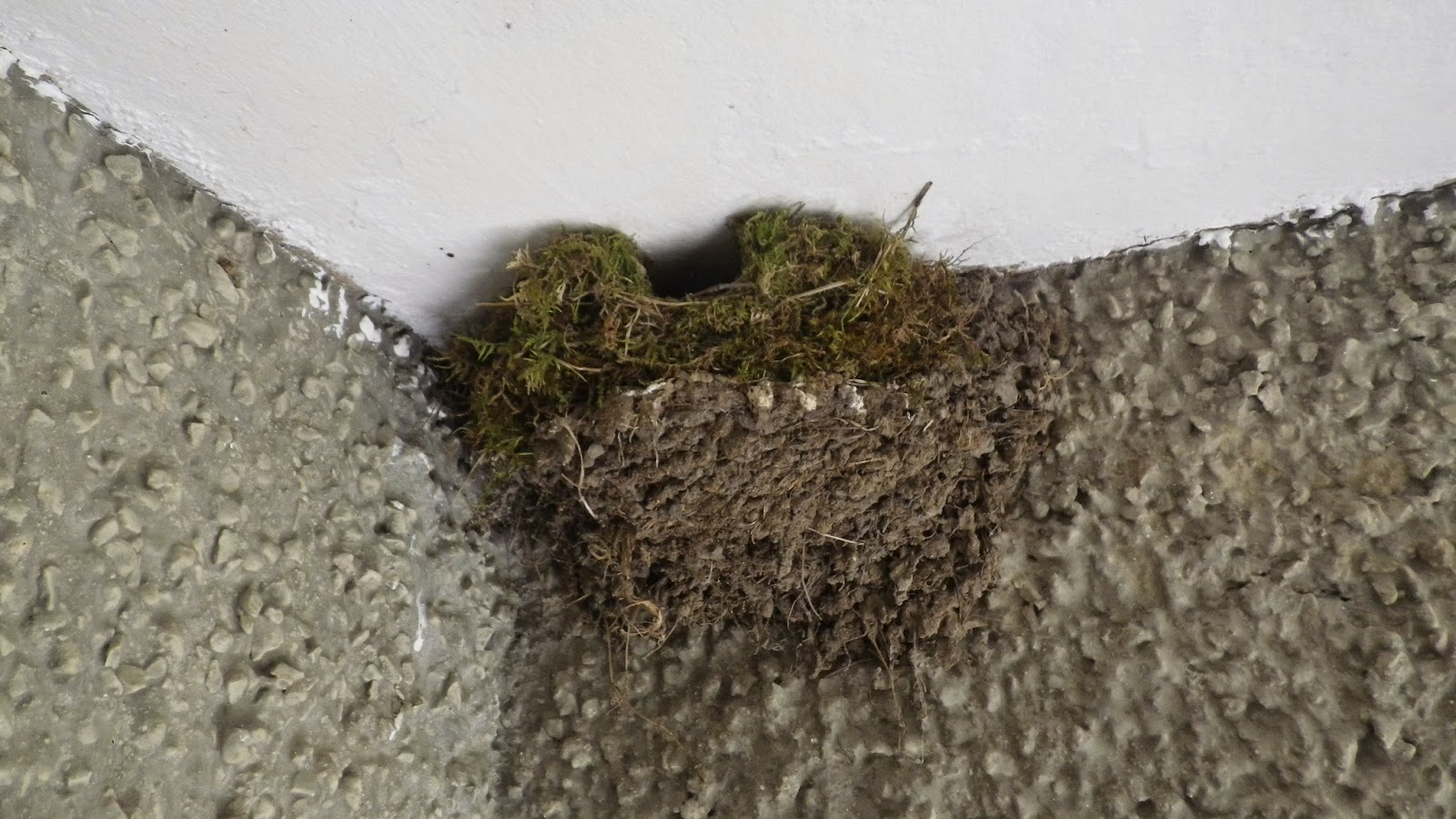
Same nest, different tenants - squatter's rights for birds!


Everyone know it’s good to recycle or if possible re-use, but it’s not just us that does this.Two summers ago we noticed Swallows taking a great deal of interest in the toilet block at the volunteer centre here at High Wray. We always keep the door shut, to stop them flying in and getting stuck, but in this instance they were interested in the alcove above the door – an ideal nesting spot it would appear. Over the course of a couple of weeks we watched the nests build up, with both adults bringing in mud and plant material to make a lovely firm construction.

Soon after completion we were delighted to spot the female sat on the nest. We were worried at first that she’d be put off by people heading in and out of the loo, but she’d briefly exit the nest whenever anyone passed before quickly returning. A couple of weeks later we noticed she was exiting the nest a little more often and spotted tiny fluffly feathers poking out over the rim of the nest – they’d hatched!


Young and virtually featherless, the young not long hatched
It took about another 3 weeks for them to steadily grow to the point where they were hanging out over the sides and it seemed a wonder they didn’t force each other out of the nest! Shortly after that, we checked one morning to find they’d all gone (without so much as a thank you).

Shove over! The considerably bigger young almost ready to go

The next year we hoped they would return as Swallows will often repair and re-use old nests, but were disappointed to see no sign of action. By the end of the summer the nest above the gents loo door was starting to look very run down, with the ladies one holding together much better.

New tenants move in!

So we had our fingers crossed for this year but it looks like someone beat the swallows to it. It appears that a Wren has decided the ‘ladies  nest’ would make a perfect base for its own construction and has built an exquisite (and very snug looking) extra layer on top of the original base. It looks like it had a go at the ‘gents nest’ as well, judging by the tatters of moss poked into some of the holes, but obviously agreed with us on the state of it and must have given it up as too much hard work.

The 'gents nest' - not sure about that .....

Much better! The 'Ladies nest' with cosy adaptation

We’re not sure if this adapted nest has ended up being chosen by the female Wren (males normally build several nests, from which the females chose their favourite), but we’ll keep an eye on it over the coming weeks. One things for sure, with the swallows having just reappeared on the scene here (see last week’s entry on migration) they’re likely to get a big surprise if they decide to return to this particular site!

By Rob Clarke, High Wray Basecamp community ranger

6 March 2015

100 working holidays and counting .....


Working holidays are a great way to get involved with the National Trust’s work and some people return many times to take part in them. Some go that extra mile though and Di Lang is a great example of this. A long standing working holiday leader (the leader is not staff but takes charge or housekeeping, shopping, menus etc), Di led her first holiday here at High Wray back in 2004 and recently returned here to lead her 100th!

Di (left) on the 100th holiday

Di has led holidays as diverse as Drystone walling and hedgelaying, woodland management and running events. We’re particularly thankful for her formidable organisational skills and boundless enthusiasm in leading our upland adventure holidays, where participants camp out on the high fells for three nights and work to reduce path erosion in the day.

‘I’m from a farming background’ Di says ‘I always used to be out with my Father when I was growing up. My career took me on a different path, running my own flooring business, but one day I noticed a hedge by the side of the road. ‘That’s a well laid hedge’ I thought, then thought ‘that’s my father talking’. So I went to agricultural college and did a few short courses, then looked into conservation holidays and found the National Trust’s Working Holidays and I’ve stuck with them ever since.’

So what is it about Working Holidays that keeps Di coming back for more? ‘The variety, the places you go to and the people you meet. I love the extra knowledge you learn as I think your brain is still a muscle that needs working. It keeps your body moving as well! I enjoy the social elements too, meeting new people and some of their experiences and backgrounds are amazing. No working holiday is exactly the same either, you may come back to the same Basecamp but the dynamics of the group are completely different.’

‘The High camp ones are really special to me and I love footpath laying too. I’m off to do scything this year, because we’ve got a grassland area close to where we live and we want to turn it into a wildflower meadow. It’s new skills again. I’ve discovered I’m not really a gardener though – it’s too tidy!’

On the fells on a camping holiday
Floored!
To cap it all, to mark the 100th holiday Di stayed on a week at the end of it and with the help of ever supportive husband Max brought her flooring skills to bear by replacing our tatty old vinyl floors with a new hard wearing surface. This looks great and should last for years to come

‘I sort of think of High Wray as a second home now and when I was here another time I was looking at the floors and thinking I could put a new floor down to make it more attractive for people to come here. You get a pride in your work when you’re doing something like this and it’s nice to think that other working holidays and volunteer groups will get the benefit of this in the future.’

Di reclines on the newly fitted and very smart floor in the 'Acland' block, with 100th working Holiday presentation picture
We’re looking forward to many more years of working alongside Di, with another camping holiday scheduled for this May. It’s thanks to the dedication and hard work of leaders like Di (and there are plenty of others too) that the National Trust is able to offer such a varied and interesting working holiday programme, enabling many people to get involved with our work and help us look after our special places for everyone.

We’ll leave the last word to Di:

‘I’ll be carrying on with working holidays as long as I can, I’ve no intention of giving up. I still get excited every year when the new brochure comes out and I’m straight in there looking at where working holidays can take me this year.’

Rob Clarke, Basecamp Community Ranger

Find out more about National Trust working holidays here:

6 February 2015

Friends, Romans, Hedgelayers


 Friends, Romans, hedgelayers … 

One of the great things about working at High Wray it is that we are playing our part in helping to keep traditional skills alive. One such skill is hedgelaying, which is carried out all over the country with regional variations in styles and techniques. It’s a fascinating process with a long history – according to the National Hedgelaying Society in 55BC Julius Caesar mentioned a tribe in Flanders using techniques recognisable today.

Hedge with a view


A winter task often means chilly conditions!
Hedgelaying is a job that can only be done in winter when the sap is not rising. It involves cutting hedge plants most of the way through their stems and ‘laying’ them on their sides to form a stock proof barrier. The traditional tool for this is the Billhook, although often today hedgelaying is done with a chainsaw.

A billhook - lots of regional variations available ...
 As well as looking good, a laid hedge provides shelter for the stock, encourages new growth in the plants and makes good ground cover for wildlife. The regional variations come (amongst other things) with the differences in how steep an angle you lay the plants, how wide and high your hedge is and where you put wooden stakes to hold everything in place.

Finished stretch of hedge, quite late in the season (note leaves on plants)
Collateral benefits

So it’s a satisfying, traditional skill that many regular local volunteers look forward to each winter – although for some we’re sure that has a lot to do with the fact that when you’re hedgelaying you generally have a nice big fire to burn all the excess bits of wood!

Utilizing the fire in a vain attempt to dry out the thorn proof hedgelaying gauntlets
We also run National Trust hedgelaying working holidays which adds an extra level of interest for us as we will often have some quite experienced people from other parts of the country turning up to ‘see how we do it here’. Not only do they bring different knowledge and experience we can pick up on, they sometimes bring all sorts of interesting tools and equipment for us to admire too.

That's some very interesting equipment - A working holiday participant's wood burning kettle
By the time we finish this year’s hedges the season will be over for the year and we’ll be moving on to other tasks. We look forward to this time, not because we don’t like hedgelaying but because the end of it heralds the start of spring and all that glorious sunshine that’s no doubt heading our way …..


Find out more about National Trust working holidays here:


By Rob Clarke, Basecamp Community Ranger