Showing posts with label wildflowers. Show all posts

27 May 2016

In praise of bluebells


In praise of bluebells

A fine and subtle spirit dwells
In every little flower,
Each one its own sweet feeling breathes
With more or less of power.
There is a silent eloquence
In every wild bluebell
That fills my softened heart with bliss
That words could never tell.

Anne Bronte, 1840.

 They’re on the wane now, those carpets of frosted blue, melting back into the woodland floor as the mercury rises and the canopy closes over. Yet for an all-too-brief window every spring, bluebells bring woods all over Britain bursting into life. To many these azure seas of flowers are as emblematic of the returning sun and lengthening days as the call of cuckoos or the sight of swallows. It’s little wonder that our native hyacinthoides non-scripta is amongst the favourite of the nation’s wildflowers. This charismatic, ‘eloquent’ little flower is rich in folklore and history too, and perhaps because they are found in ‘ancient’ woodland, or perhaps because they contain poisonous glycoside compounds, bluebells have long been associated with fairies. Legend has it that the ‘bells’ were rung to summon fairies to gatherings deep in the woods, but should the ringing fall upon a human ear, alas death would soon come upon that unfortunate soul. 
 
A meeting place for fairies?

To witness the spectacle of a bluebell wood in full bloom, whilst hopefully avoiding an untimely demise, there are few better places than here in the Lake District. Bluebells have a preference for oceanic climates, so the UK, and the west coast in particular, with our prevailing weather bringing mild and wet fronts off the Atlantic, creates the perfect growing conditions. In fact, so well suited are they to our climate that the UK is home to around half the world’s population of hyacinthoides non-scripta.

Bluebells also grow best in undisturbed soil, in ground that has remained free from the plough or other intrusions for as long as possible. They tend to take a long time to become established in new habitat, yet this apparent torpidity also means that they can linger long after conditions have changed. Like organic archaeology, to come across an open field of bluebells is to bear witness to a changing landscape, a persisting footprint of a now-vanished habitat. They, along with a handful of other plants, are an indicator of ancient woodland. Ancient in this sense meaning pre- 1600 AD, before maps became widely available and woodland management became commonplace, though some may have lineage that traces all the way back to the most recent ice-age, 10,000 years ago. It’s a rare and shrinking habitat, covering just 2% of the UK’s land surface, though unfortunately it’s rarity often doesn’t equate to value, and many sites remain unprotected in law, at the mercy of human development and exploitation.
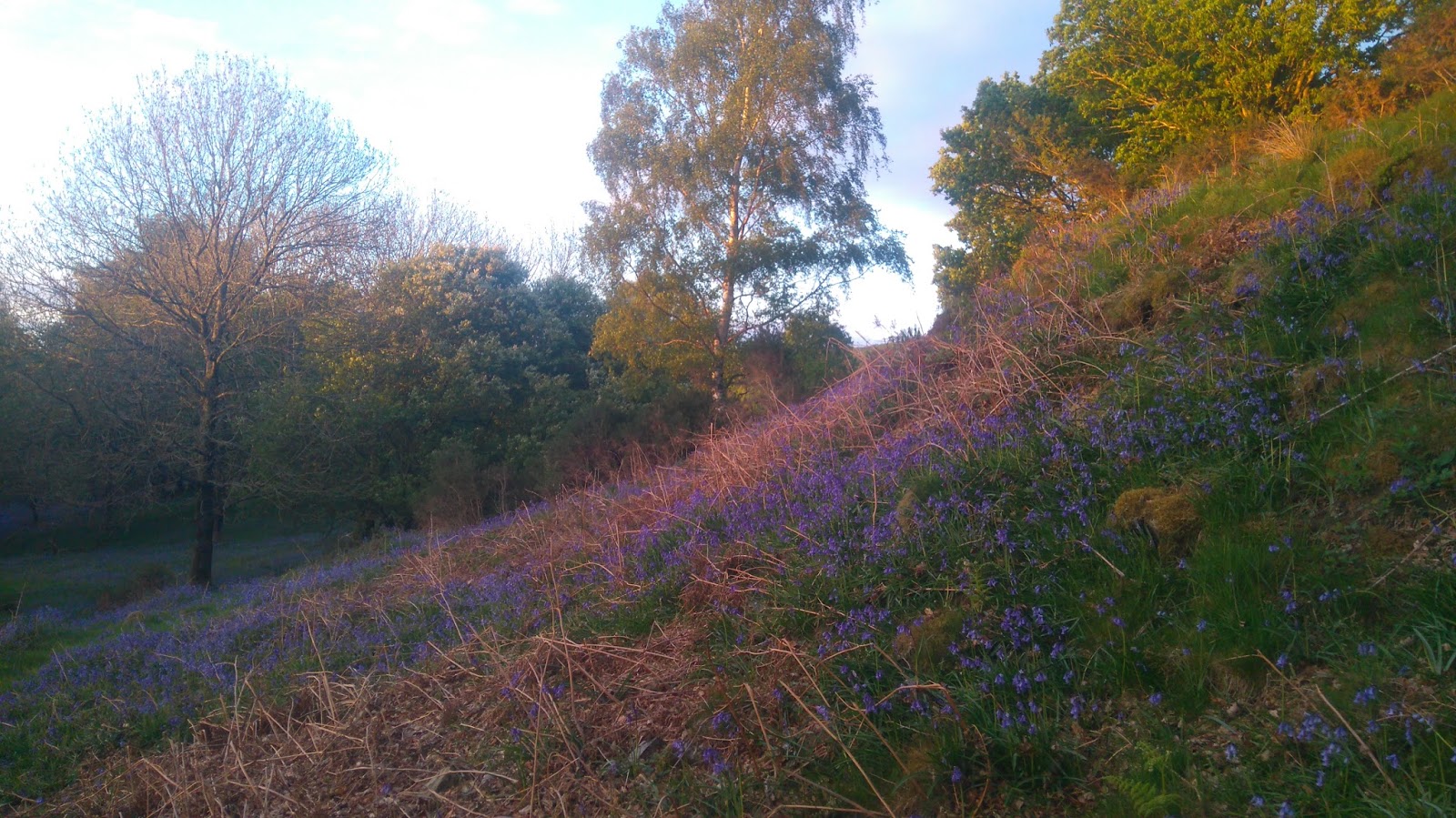
Bluebells in open habitat are an indicator of ancient woodland.

Bluebells themselves however, do enjoy a certain level of protection. Although not officially endangered, since 1998 it has been illegal to collect them for sale, and they are further safeguarded from intentional uprooting under the Wildlife and Countryside Act of 1981. The major threats to our native flowers however, come in rather more subtle guises than unscrupulous plant collectors. They first started to appear in the 1960’s, immigrants from Spain escaping from confinement in gardens and parks. Over the following decades increasing amounts of this modern-day Spanish armada has appeared in our woodlands. More robust, more adaptable, and more vigorous than UK bluebells, hyacinthoides hispanica will out-compete native flowers wherever they gain a foothold. To further cloud the picture the two species will readily interbreed, producing a hybridized variety with characteristics of both, and which could ultimately lead to the loss of the genetically distinct non-scripta species. Ominously, in a recent survey by the charity Plantlife, it was found that one in six bluebell woods contained either Spanish or hybrid bluebells alongside native UK plants.

Recognising the three varieties of bluebell now encountered in the UK woodlands (image reproduced courtesy of Cumbria Wildlife.org).

Yet it is it is a different threat which represents the most uncertain future for our beloved bluebells. Native seeds can and are being banked. Spanish invaders can to an extent be eradicated (though it is illegal to uproot any plant without landowner consent). A changing climate however, could see bluebell carpets disappear into memory as the ecological niche to which they are so superbly adapted is swallowed up by shifting patterns and seasons.  If the trend for earlier springs continues, the advancing overhead canopy and competition from other plants on the woodland floor could close the window on bluebells forever.
Could sights like this become a thing of the past?

I for one hope not. I hope that the spectacle of a bluebell wood in full bloom, surely one of the most delightful and uplifting treasures of the British countryside, is around for many years to come. I hope that future generations can experience and wonder at their subtle majesty, and fill their own softened hearts with bliss as they do so.
25 September 2015

Learning to love our beautiful bogs


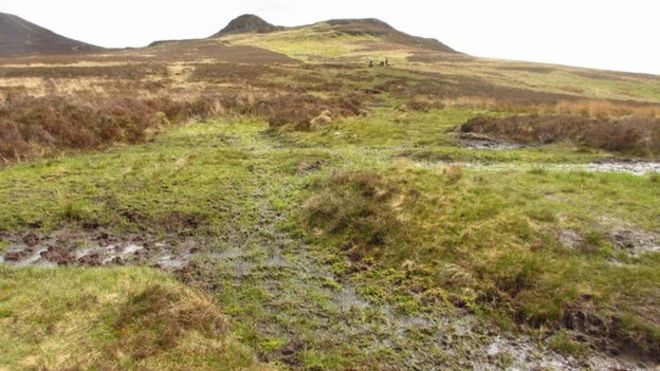
Anyone who’s walked the Lake District will have had an experience where they’ve sunk up to their knees in a bog. But next time you’re cursing your soggy feet, bear in mind that bogs aren’t all bad – they’re amazing habitats that also provide all sorts of important benefits for humans.

Walla Crag
A typical boggy scene facing the hill-walker (LDNPA photo)

There are a couple of types of bog in the Lakes. Blanket bogs cover vast areas and sit on top of flat plateaus; these are mainly found in the north and east Lakes, and are more typical of the Pennines and Peak District. Much more common, especially around our patch in the south Lakes, are flush bogs. These form in smaller, flat hollows on hillsides and hilltops where the movement of rainwater slows down, leading to permanent waterlogging.

Sphagnum mosses

Sphagnum mosses are easily overlooked but they're beautiful species in their own right. Good quality bogs can hold around ten different species. (Photo Rob Clarke)

The wet ground is colonised by carpets and hummocks of sphagnum mosses, which are ‘keystone species’ in bog formation (species which produce an environment that other species need to survive). Sphagnum thrive in the acidic flushes and create a layer of peat, made from the dead plant material that doesn’t decompose due to the cool climate, waterlogging and its own acidity. As the peat doesn’t decay (as long as it remains waterlogged) it can build to many metres deep. This wet, peaty environment then provides a home for other specialist plants such as cottongrass, bog asphodel, cross-leaved heath, and the insectivorous sundews; they subsequently support a specialist range of invertebrates, as well as birds like curlews.
Sundew growing amongst Sphagnum moss (Wikipedia photo)

How bogs help us

Peat bogs aren’t just great for wildlife, they’re vital for us too. By slowing down the flow of water off the hills, they reduce flooding downstream, and help improve water quality. As the plant material that is sat, undecomposed, in peat is primarily carbon, they are also a huge carbon store – in the UK, they’re our biggest resource of carbon (with 22m tons stored in the Lakes alone) and have a net cooling effect on the climate.

South Lakes rangers puzzle over the identification of a Sphagnum moss at one our important bogs (photo Rob Clarke).

Bogs in trouble

Their importance for carbon storage and water management can mean that threats to bogs have serious consequences. Over the last few decades, peat has often been drained to improve grazing for sheep, and was traditionally a source of fuel (although this practice is fortunately fairly rare in the UK today). Dry, degraded peat bogs are prone to erosion from rain, which unlocks stored carbon, increases the speed of run-off, and requires increased treatment where water is collected for drinking. Eroding peat bogs in the Lakes are thought to be emitting about 32,000 tons of carbon every year.

Here at South Lakes, we look after our flushes by damming drainage ditches to ‘re-wet’ bogs that have previously been drained, and by clearing the encroachment of trees where necessary, which can also dry them out. We also build appropriate paths through bogs to ensure ease of access and stop people ploughing through sensitive habitat. Elsewhere in the country, huge projects are underway to re-wet entire blanket bogs, often paid for by utility companies because it’s cheaper to improve the water quality at source than to treat it when it comes out of the reservoir. It’s likely that ‘eco-system services’ like this and carbon storage will become an even more important part of our economy in future.

So, next time you’re confronted with a bog on your fell-top ramble, try not to curse and remember all the wonderful things the unsung heroes of Sphagnum and peat are doing for wildlife, and for us!

30 April 2015

Beyond the bluebells


Spring in the woods means only one thing to lots of people: bluebells! Vibrant carpets of the delicate cyan flowers are a quintessential British experience at this time of year.   

And it’s not just a spectacle; Britain is home to fifty percent of the world population of this species of bluebell. As plants recolonized the northern latitudes after the last Ice Age, bluebells reached Britain just before the sea level rose and cut us off from the continent, so lots of other plant species never arrived here.  In the rest of Europe, bluebells are out-competed by some of these species, whereas in the UK they are free to thrive.


But I’d like to take you beyond the bluebell. Although bluebells are spectacular, my favourite time of the woodland year is actually a couple of weeks earlier, when some of the other woodland wildflowers are the real first sign that spring’s on its way.  Like bluebells, these plants have adapted to life in the woods by flowering before the trees are in leaf, so they make the most of the sun.  They don’t always form such a dramatic carpet on the woodland floor as bluebells, but often the fact that a number of different species are clustered together - with their diversity of colour - makes for a sight to gladden the soul.

Wood anenome


Wood anenomes Anenome nemosa are one of the most important indicators of ancient woodland.  They reproduce through rhizomes (root-like structures) that only spread about six inches a year – this means they don’t colonise new sites easily, and the presence of a large population means that a wood has been undisturbed for a very long time.  They can also provide an interesting clue to previous land uses, as they're sometimes found on open ground – but this is a strong clue that the area has been wooded previously.

Lesser celandine


Like wood anenomes, lesser celandines Ranunculus ficaria can be found in a variety of habitats, but usually give us a clue that the area has been wooded at one point.  It is sometimes known as ‘the spring messenger’ as one of the earliest flowers, and William Wordsworth was inspired to write three poems about the plant – famously, however, the celandine carved on his gravestone is the wrong species, the greater celandine.  It is also sometimes known as pilewort because there is an old folk belief that the crushed roots could make a lotion for piles when mixed with wine or urine!

Wood sorrel


Wood sorrel Oxalis acetosella is probably my favourite woodland wildflower despite its ubiquity.  It particularly thrives in cool, shady woods  - of which there's no shortage round here - and can tolerate shade much darker than other plants. In the Lakes, it often grows out of the mossy carpet on the woodland floor or even from moss growing on tree branches, creating lush hanging gardens in the canopy.  The leaves are delicious and taste of apple peel, but don’t eat too many as they also contain Oxalic acid.  Wood sorrel is one of the more widespread flowers globally and is native as far north as Iceland, south down to Greece, and east as far as Japan!

Wild garlic 

Wild garlic Allium ursinum is another very common flower of damp woodlands and lends the woods their distinctive garlicky aroma in early spring.  The latin name means ‘Bear’s garlic’ and is so-named because where they still exist in Europe, brown bears love to truffle up the roots! Both the leaves and flowers are edible and have a more gentle taste than culinary garlic – wild garlic risotto is a personal favourite.

Primrose


Primrose Primula vulgaris has been under threat in England over the last few decades because of people digging plants up to put them in their garden – fortunately attitudes have changed and this sort of thing is much less common now.  Primroses can be seen anywhere that’s undisturbed, cool and slightly shady, so our Lake District oakwoods are great places to find the lemon yellow rosettes. 

Get out and see 'em!

The South Lakes is home to lots of fantastic native woodland so it’s the perfect place to get out and see woodland wildflowers in the spring.  The woodlands on Windermere’s west shore, along the Yewdale bridleway, above Glen Mary car park, or along Coniston’s east shore are particularly special places with rich flora and incredible atmosphere – make sure you don’t miss the spectacle, it changes day by day at this time of year!